Bread - Number 23: The Spelt Variations
Like the Goldberg Variations, but more tasty
Purchases: Internal food thermometer $35 with shipping (half=price sale at Thermoworks)
I made the same 100 percent spelt bread three times to learn from mistakes, correct mistakes, and reach perfection. Reached pretty good. Thank you to my new trusty internal food thermometer, I did not bake the last loaf to death and before the end of the day, I personally consumed half of it.
Lessons learned: This recipe should not be left to rise overnight on the counter. The dough will over-rise, causing sadness even though less than a dollar of ingredients have been ruined, even though more starter is available, and even though the world is not nearly at an end. Other options are putting the dough in the refrigerator sooner or using less starter, both in an effort to slow down the process and sleep through the night while the dough rises.
Another lesson: An internal body clock will wake you in the wee hours of the night if there is the slightest suspicion that the dough will over-rise, not in time to catch the dough at its peak, but probably at a point where an edible bread can be produced.
Yet one more lesson: No recipe can totally account for different room temperatures, differences in flour batches, and the sourdough starter's phase of the starter cycle of eating and resting at which the starter was added to the water to make the dough. Get friendly with the dough at each stage and learn what it needs along the journey.
Scientific test coming: Whether dough rises better and bread is of higher quality if starter is at a phase where it will float in water or whether rising time will vary, but bread quality not affected.
Essentially a do over
Used the breadtopia spelt sourdough recipe. Same as Bread #7, but this time with starter instead of yeast, and no sweetener. The recipe comes with two in-depth videos
that effectively walk one through the process. Recommended for
beginners. In my three variations, I used different starters, the third
time with a spelt starter. I also varied the sizes of the loaf, the
rising times, the number of stretch and folds, and the baking times.
[Photo of starter right after being fed.]
Ingredients
280 g water
11 g spelt starter
424g spelt flour
1 1/2 tsp salt
oats for coating dough (before placing in oven)
Instructions
Mixed water and starter first. Starter did not float. Added flour and then salt. Really enjoying the digital scale. Easy to use and clean. Very precise measurements in grams or ounces.
I did three stretch and folds at intervals of 20 to 30 minutes. I admit that I varied the number and the timing of the stretch and folds without any apparent consequences for the dough. [Photos are two different doughs after the third stretch and folds.]
Afterward, I let the dough rise on the counter for about five hours, perhaps less. Any more, at least in a springtime kitchen, was too much. Place in fridge or proceed to final rise and baking. I left mine in the fridge on the second try for 26 hours and that seemed like too much. I think the dough went past its peak rise.
Shaping and Preparation
Breadtopia man recommends an easy shaping technique for this bread. Essentially, take "corners" of the dough and bring into the center so that the dough becomes a sphere. Then handle around for 30 seconds or so until the shape becomes a classic boule. It is described on breadtopia as an alternative to a direct degassing technique, such as punching down the dough. Then refine the shape further if necessary.
Leave the dough on a well-floured board, loosely covered in plastic, for 15 minutes.
At this point, prepare your bowl, banneton, or basket for the dough's final rise. I used a bowl sprayed with baking spray. I poured some oats over the baking spray so that what would become the top of the bread would be covered with oats. That worked out well - plus there were plenty of nice, roasted oats that fell off at some point in the oven. Quite tasty.
I turned on the oven to 500 degrees to get it nice and hot. Be sure to put in the la cloche and baking stone or whatever you are using to create a steamy environment in the oven. My oven seems to need a good hour to get that hot, according to an independent thermometer, though the oven claims to heat up much faster.
At 15 minutes, place the dough in the bowl or whatever. Allow the bread to enjoy its final rise for an hour to an hour and a half. Mine lost its shape, which made me nervous, . This dough was sufficiently dry to get in the oven with just flour on the baking peel, but I admit that parchment paper is better insofar as it reduces anxiety and does not seem to compromise the bottom of the bread.
Baking
Turn the dough gently onto the peel if you are using one. Just before putting the dough in the oven, score your line or design on top. I always do a star with the bread knife, which generally, if I'm lucky, produces a cross. I am getting tempted to go out and buy razor blades to do some fancy scoring.
Reduce the oven temperature to 450 degrees. I put a note right near the oven to remind me because I forget this part.
At 30 minutes, remove top of la cloche and parchment paper. Take the bread's temperature. Mine was 203 degrees at this point. It was good to have this information as otherwise I certainly would have left the bread in the oven for too long. In fact, I did that the first two times. I was so excited that the thermometer was already proving its value.
And?
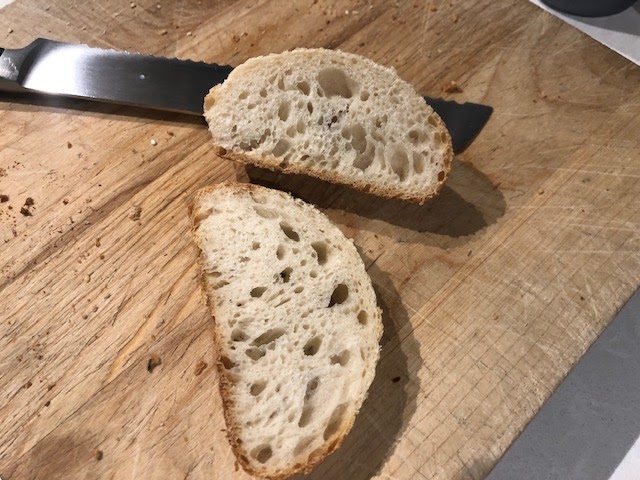
A nice crackle. A beautiful bread. Two hours later: A heavenly taste. I waited for a late breakfast of tea and butter on the spelt sourdough. So, so good. I ate half of it before the afternoon was done. It's the cross on top. Works every time. I'm still Jewish. No plan to convert just because the cross seems to be the good luck charm.
The best part is that I made a wonderful bread with my own starter.
Bread - Number 22: Grateful for a number
Must admit to losing some momentum for the bread project and this is where gratitude comes in for the number 108. If not for the number, I would probably already have taken a few easy, good recipes to add to my previously tiny repertoire of breads (okay, there were only two bread machine recipes before 108 breads began), and having learned a bit, would be fine with the knowledge gained, not upset that bread making had not been mastered.
I am generally okay with not mastering any given subject. I like what I like in art, wine, food, horticulture, movies, books, whatever, without any knowledge of the details of official excellence. In fact, I eschew the idea that other people define what makes something good, when that something is a matter of taste. But I also tend to start and stop projects, to not commit, to not get into anything too deep.
The value of the number 108 is the commitment to something definite. With 108, there is no doubt that 22 is not enough. To stop before 108 would be to break the commitment to myself to experiment and learn for a long time about one particular task, a very old task, in a big, modern world. (Perhaps I need to buy that slow movement book.)
Plus, now I am totally addicted to bread ovens, to books, to people describing their recipes and crumbs. Hydration rates are still a challenge.
Might not make another totally new bread for a month. Will try some previous breads with the starter first and then perhaps with autolyse. Will take time to get the spreadsheet up to date. Will take the 108 a little more slowly, not rushing to bake bread after bread, but to pause to watch helpful videos and do more reading - without the pressure of constantly keeping an eye on the next bread. No rush. 108 breads is for my own enjoyment and some good eating. There is no deadline.
Half whole wheat and flexible
Bread #22 is 50 percent whole wheat and lends itself to a working schedule. However, fitting this bread into an typical office/home schedule, would require some early-morning mixing. There are dough phases that require 12 to 14 hours on the counter or where dough can be stored for the day in the refrigerator. It is the levain build bread, from Bread by Jeffrey Hamelman.
Ingredients
Levain stage
2.4 oz. water
small ladle full of starter
2.4 oz. whole wheat flour
Dough
1 1/16 cup (8.65 oz.) water
5.6 oz. whole wheat flour
8 oz. bread flour
1 1/2 tbsp (.3 oz.) salt
add levain
Evening start
Spent most of the evening pondering what bread to begin and being too lazy to go to the basement for any spelt, rye or oat flours. Truthful, but not proud. Yes, the one-minute walk down the flight of stairs determined the selection.
Mixed the starter with water and then, Danish whisk in hand (love that thing), mixed in the whole wheat flour. Covered with plastic and left overnight. What began as a small pile of shaggy dough was a wet, only slightly bubbly, sponge the next morning. Nicely risen, though not many holes. Perhaps my starter has also lost some of its momentum.
[Levain at 10 hours.]
Instructions were to allow levain to rise on the counter for 12 to 14 hours. The house was quite warm - maybe 80 degrees (love April in DC) - and at 11 1/2 hours, it was almost time to leave.
So mixed in dough ingredients with levain. The recipe stated that the dough should be, and I quote, "moderately developed," a phrase so vague and unsuggestive of texture or appearance, that I made an entirely clueless determination. To be fair, the author gives instructions for number of minutes and speed for a commercial mixer. Here is where I left.
Please do not judge if you are thinking something like - wow, she really does not know what she is doing - or - a few minutes of mixing is worth a good ten minutes of hand mixing. Patience is a virtue I keep working on. This is why I fantasize about the Scottish bread making class. That and travelling in Scotland.
Confusion
Totally my fault that I then got confused when the recipe referred to bulk fermentation and folding as though those were tasks that would be accomplished in two completely separate periods of time. Returned 2 1/4 hours later, glanced at the part of the Bread book that discusses bulk fermentation, only to discover that every 50 minutes to an hour there should have been a stretch and fold of some kind. Oops.
Here are a couple of photos at 2 1/4 hours of bulk fermentation without folding.
And ...
I did one stretch and fold at 2 1/4 hours, then placed in floured bowl for the final rise. At this point, I was betting that this dough was not worthy of too much more of an emotional or temporal investment. Though instructions called for a final rise of two to two and a half hours, it was over 80 degrees in the kitchen and the dough was massive at one hour.
Upon restrospection and with the benefit of viewing the photographs side by side, perhaps massive was a misimpression.
Baking
Preheated oven to 460 degrees, placed top of la cloche in the oven on the baking stone, and waited a little under an hour before placing the dough (scored with a star on top) on parchment paper on the baking peel and into the oven. The dough was wet, sticky and not keeping a great shape. At 30 minutes, I removed the parchment paper and then checked the bread at 40, 45, 47 and 50 minutes. Each time, I listened for that wonderful crackling sound and expected more. Afraid I left the bread in too long.
The taste was a bit dry and the bread needed more of a rise, no doubt the consequence of missing the stretch and folds during the first rise of the dough all mixed together.
Warning #1: Storing some flour in the basement freezer requires that one extra step of walking down the steps to get the flour. This leads to hesitation to use said flour in starters and breads. Keeping the flour upstairs will necessitate one quarter to one third of freezer space to be allotted to flour. Spouse will have to be notified and reasoned with. Spouse will consider this additional evidence of bread obsession.
[Photos here are of the bread ovens at Pepe's Pizza in New Haven. A pizza worthy of New York. Really Italian. I wanted to bake bread there. Immersed in the incredible slices.]
Warning #2: Reading thefreshloaf feeds a bread obsession. More recipes and tips exist than can possibly be attempted. Add in breadtopia and the danger exists that all time will be spent reading about bread, watching dough-related videos and poring over recipes. If you lose your job and people refuse to meet your gaze, you have gone too far.
Warning #3: Care should be taken to make some breads for friends, family and work colleagues. Each bite will buy a small increment of time during which they will tolerate your descriptions of crusts, crumbs, doughs and sourdough starters. Also bread successes shared will endear you to them, though they might start describing you as the crazy bread person.
Warning #4: Checking the starters in the middle of the night, first thing in the morning or directly upon returning home from work does mean you have crossed a line. The dog, and perhaps other types of pets, will not judge you. Teenagers and many others will.
Warning #5: Despite repeated admonitions to oneself, despite sleepiness and misjudgments, and despite the knowledge that a better bread will not happen, you will get up in the middle of the night, go to sleep very late and wake up well before dawn to mix up and tend to doughs and starters.
Reality: Yes, the line has been crossed. Next up is continuing to fill out my in-progress spreadsheet with bread data. Busy working on another bread - #22 - and feeding the starters. In the process, enjoying my digital scale and Danish whisk. Change jars to rotate Rye into clean jar. No longer an actual rye starter, but the name stays. Would have to go down to the basement to retrieve the rye flour. Not happening. Too late. Spent too much time reading recipes.
P.S. Decided after Bread #22 to take a break, make some breads from the early successes a few more times, and concentrate on building knowledge and skills for a little while.
P.P.S. Also, now that it is spring (and DC is a beautiful area of blossoming frenzy this time of year), have resolved to finish painting a table - also sitting in the basement - and to paint something on that large canvas earmarked for the dining room. Yes, sitting in the basement.
P.P.P.S. Will still write as bread books to be read, bread videos to be watched and bread techniques and history to be learned. 108 is too far away to know whether it is not enough.
Bread - Numbers 20 and 21: Back in the groove
Conclusion first. Back in the game. The breads came out well. Solidly good. Both whole wheat and rye bread with 50 percent white bread flour. Tasty and immediately went from Bread #20 to #21, variations on the same recipe from Bread, by Jeffrey Hamelman.
Birth order - being last helps with the bread quest
Being last in a family of three children means until you are older, someone else has been everywhere you arrive at first. Being last means working hard even knowing someone can and probably will be better, at least for a few more years. It means having a visible path and the counsel of someone incredibly cool. Being last means comparing your siblings' old report cards with your own to measure yourself against the experience of your siblings.
Being last means the lazy way out is definitely an option. I did not walk on my own until I was a year and a half old. I could walk, but my brother or sister were always around to take my hand, and I, apparently, was glad for the company, the love, and the avoidance of responsibility. I still prefer not to drive; I sign the tax return without a glance; and do not care how technology works as long as it does.
Being last means being the quirky one, the one who is not enamored with hierarchy and convention. It means saying things like "I'm growing my own yeast-like substances and I've named them Wheat and Rye. I feed them. ... Look at those beautiful bubbles. ... Listen to that crackling sound." And expecting everyone else to be as excited as I am.
Being last means being forever young and expecting to be adored. Even in the workplace, even those times on the receiving end of the teenage death stare or scream, even when breads do not turn out well, there's a sense of having created something wonderful and knowing that, since someone else came this way before and lived, everything will be alright and lovely, in a quirky way.
So if a bread is a disaster, if I felt during the last few bread cycles as if my mojo were gone, there was humor and ease that it is okay not to be a superior bread maker yet and just to be one who is trying.
Recipe
Breads #20 and #21 were variations on the same recipe, the whole rye and whole wheat bread from Bread, by Jeffrey Hamelman. Bread #20 was the exact recipe. See the book review. Finding I like his descriptions and approach. Also becoming addicted to thefreshloaf forum. (For more, on the review page there is a detailed description of the forum.)
Ingredients
Phase one - sourdough
rye flour 4 oz.
Water 3.3 oz.
sourdough - recipe called for .4 oz. I put in a small ladle full without measuring.
Phase two - dough
bread flour 8 oz.
whole wheat flour 4 oz.
water 7.6 oz.
salt .3 oz. or 1/2 tbspn
Bread #20: added .06 (1/2 tsp) yeast
Bread #21: totally sourdough, no yeast
The only other difference in ingredients was that I used a whole wheat starter the first time and the second time used that same starter, but fed once in between with rye.
After mixing during each phase, covered bowl loosely with plastic.
Note: Not yet crazy enough to jot down hydration rates, but getting closer.
First rise
On bread #20 , I allowed the sourdough to rise for 12 hours. No discernible difference in taste with bread #21, which rose for 14 hours. Fourteen to 16 hours recommended in the recipe. Admit that when I make this bread again, I will experiment with a longer rise. Also, should have added caraway seeds. Adore that taste.
One note, the 100 percent rye sourdough phase one actually appears suspiciously similar to wet cement. Not a spongy sponge. Would not be surprised if this substance were used to fill in between bricks.
On Bread #21, the sourdough phase one, birthed in a 5 a.m. kitchen with a baker who had one eye open. Carried it down the stairs to the basement. Left the sourdough to sit in the coolest space in the house, literally on the washing machine, because on this fine April day, the temperature one block from the District of Columbia, reached 90 degrees.
Dough
Felt guilty on Bread #20 for using some, even a little, commercial yeast. Thus, Bread #21 was an attempt to try same recipe without that crutch. Starter alone as the yeast source performed fine. Again, I will try for longer rise next time.
On mixing dough, it seemed as if it would be too dry. Took some time to mix in all of the flour, but ended up being sticky and somewhat wet when completely mixed. Loving that danish whisk.
Note to self: Stop torturing yourself with 5 a.m. wakeups to tend to dough. This is why essential ingredients like caraway seeds are forgotten. Also, end up doing exercises in the kitchen and taking kitchen timer to the shower so that morning routine can be squeezed in around bread making. End up sleepy and wanting only to read thefreshloaf forum entries.
Bulk fermentation - rising of the whole dough
Bulk fermentation - dough stage rise - after mixing dough with sourdough was only one hour. Also, because this was a rye, Hamelman advised no kneading or stretch and folds.
After one hour bulk fermentation, put the dough in the refrigerator for several hours each time. Dough continued to rise in fridge. Actually, rose great in the fridge. I should have kept it there up to a day longer. My impatience gets the best of me.

[Bread #20 on final rise. Showing bad form with plastic directly on dough.]
Did remember to throw some caraway seeds on Bread #21 before baking. Still miffed that forgot to add this wonderful ingredient to the dough.
Baking
Preheat oven an hour before to 500 degrees. I used parchment paper on baking peel to place dough on baking stone as dough was wet. Covered with top of la cloche. Per recipe, immediately reduced tempurature to 460 degrees for 15 minutes; then further reduced for 25 minutes to 440 degrees. Kept top of la cloche on until the last four minutes for Bread #20 and for the entire time for Bread #21. No discernible difference.
[Spoiler alert: a peak at Bread #20]
Crackling, beauty and taste
Perhaps results each time only attributable to my remembering to score the top of the dough with the star that bakes into a cross. Pretty breads. Also, lovely, lovely crackling sounds when they came out of the oven. For Bread #20, made my husband mute the television and we listened. And this soft sound was somewhere between a crackling fireplace or cereal in milk, though far, far quieter; so quiet, indeed that it took effort to listen, as if we had to ignore the even the movement of the air, the decibel level of a pin drop.
The basketball game - the NCAA championship game - was of no interest. My stupid top pick was Syracuse, a team that did not make it to the final round. They always lose and I always refuse to have them go all the way in my picks, except this time I weakened because my niece is getting her PhD there.
Sentimentality should never get in the way of choosing brackets. Plus, crackling sound way better than the basketball college championship this year. Another time, will explain my system for winning said college basketball prediction every 10 years. A perfect alignment of luck and ignorance.
[A lovely Bread #21. Only improvement would be more of a rise - and caraway seeds in the dough.]
Bread - Number 18: Like a teenager, a starter cannot be woken by an alarm and be instantly happy and productive
Sleepy starter + changing gears mid way = hockey puck
Hockey puck = inedible
How Not to Make a Bread
Start with a sleepy, just defrosted starter; decide to throw it away; waken it too many hours later with a somewhat more awake starter; knead for the first time, having no idea how or really for how long; watch the bread not rise well at any stage. Buy something else for breakfast.
My apologies to the River Cottage Bread Handbook for an absolute failure of the sourdough recipe.
Ingredients
sponge -
167g white whole wheat flour
5/6 cup water
about half a ladle full of starter
dough -
200g whole wheat flour
1 2/3 tsp salt
1/8 cup water added to recipe
Made 1/3 of recipe for one loaf.
Instructions - though not the right word
Mixed the lackadaisacal sponge ingredients. Let rise overnight. Did not rise. Sponge sitting on counter not risen and waiting to be thrown in the compost. Added the half of the starter during feeding time before throwing the whole thing in the compost.
Sponge with added starter began to bubble. Muted hopefulness. Mixed in starter and let sponge rise for a few hours. No real rise.
Mixed in dough ingredients. Dough was very dry and added an extra approximately 1/8 cup of water. Have no idea what a kneadable dough should look and feel like. Let sit for 10 minutes and began to knead, if what I did could be considered kneading.
River Cottage instructions called for 10 minutes of kneading. Kneaded for 13 minutes, somewhat loosely following the River Cottage kneading instructions, and for longer than recipe called for because assumed my hands not nearly as strong as big guy who wrote the River Cottage Bread Handbook.
River Cottage author said dough should be "smooth and springy" when kneading is completed. Have no clue what that means for a whole wheat dough, which responds differently than white flour dough, and never produces the nice window-pane effect when kneaded.
Won't even recount rest of instructions, except for highlights.
Sensing disaster after kneading, left home and bought bread for dinner at a friend's house.
Dough seemed dry, so before placing in oven, sprinkled top with water. For good luck, cut a cross into the top. Used baking stone and top of la cloche. When removed top of la cloche after 30 minutes, bread looked pretty. Sprung enough for the top to be classic in appearance, though tiny because of minimal spring in oven.
Could not cut the bread. A nice, bread-shaped, large hockey puck. Anxiety setting in.
Bread - Number 19: Sponge imploded
Trying to make up for bread number 18, made almost the same recipe, but with a tiny bit of added commercial yeast. Let promising-looking sponge rise overnight. Too long. Had imploded by the next morning.
Glad the teens are finished because breads number 11 to 19 have not shown themselves to be a stellar group.
Time to reach out for assistance.
Observations
Observation #1 - It never helps to work when my eyes are barely open.
Observation #2 - It never helps to be in a rush.
Observation #3 - Despite good intentions, the words of wisdom in observations #1 and #2 are frequently ignored.
Observation #4 - I know what a good starter looks like, what a nice rising dough looks like, but not what a well-baked bread in the oven looks and feels like. Hence the occasions when breads inadequately baked have been removed from the oven. To buy one of those nifty $100 stick-it-in-the-bread thermometers or not, that is the question.
Observation #5 - For millennia, bakers did quite fine without nifty $100 stick-it-in-the-bread thermometers.
Observation #6 - Bakers also did quite well for thousands of years without lots of other stuff on my wish list, including a virtual library of bread books. Really have to join and start making use of the amazing loafonline forum and its own library of bread making information.
Observation #7 - Ancient bakers and those much closer to our own time used what we consider primitive technology to build much better bread ovens than we have with conventional home ovens.
That leads us to:
Fantasies
Fantasy #1 - Building or buying the bread oven. This is another expensive, but more importantly, dangerous proposition. I do not want the house to go up in flames. The neighbors might be unhappy as well if their homes went up in flames. A case, perhaps, of the fantasy being better than the reality.
Fantasy #2 -The expensive week-long bread class in Scotland.
Fantasy #3 - Baking almost every day and not just on weekends. This requires some more organization and probably more time working at home just to accommodate rising times, 30-second stretch and folds, and putting bread in the oven - all less time than a conversation. Then I would bring more fresh-baked bread to the office. It's a win-win situation.
Fantasy #4 - Hours and hours to read about bread baking.
Fantasy #5 - Hours and hours to read about bread baking, along with purchase of all of the wish list items, a fantastic bread oven, and friends and family to eat and enjoy the excellent bread. My starters would stay happy and healthy as well.
As this photograph shows, there is still space left in the baking drawer.
Bread - Number 17: Maybe there is a Jesus cross omen at work here
Again, the cross at the top of the bread or the lack thereof correlates directly with the quality of the bread. Mid-way through baking this bread, I had a "I should have had a V-8" moment,; I had forgotten to slash the dough right before baking. Although this first try did not produce a great bread, only needing a little more baking time, it was so promising as to guarantee a do-over right after Passover.
[Photo of dough after rising. See how puffy it is and notice the holes on top.]
This bread was made in three phases: the sponge, the dough, and the hours of stretching and folding. Temporal demands of various sorts and the wish to satisfy other needs took precedence and this bread was basically fit into a pre-existing schedule instead of being its own priority.
Bread making teaches patience and the importance of focusing on one activity at a time. There is value in doing one thing well - maybe at the expense of other demands. Really, to make good breads demands fitting a schedule to fit the bread rather than fitting the bread to fit the schedule - especially when one is not home full time and there is basically one day a week to concentrate on bread work.
Though this bread started with a recipe from the River Cottage Bread Handbook, those instructions were completely abandoned during the dough mixing stage and the path never turned back.
Sponge
250 g. whole wheat flour
1 1/4 cups water
ladle or a few tablespoons of starter (totally do not measure this)
Mixed flour and water in a sort of brief autolyse that lasted less than 10 minutes. Mixed in starter and covered loosely with plastic. Allowed sponge to rise overnight.
Love that danish whisk, which looks so cool and works very well. As it was late, no photographs were taken.
Dough
Next morning, wake to see a sponge with a bubbly surface. Oh, how you will admire and praise the starter that produced this transformation. Once your reverie is done, smile on face, continue to mix the dough.
200 g. whole wheat flour
69 g. bread flour (because the whole wheat flour bag was empty)
2 1/2 tsp salt (just add almost a tablespoon and it will work fine)
3/4 cup water
Added in the dry ingredients and this dough seemed dry. Also was totally intimidated that this dough would require kneading, so on the fly added water to transform it into a no-knead bread. Okay, not only intimidated, but tired as the clocks had sprung forward, which sounds chirpy and peppy, but just means it's earlier than you think - really 6 a.m., not 7 a.m. Went rogue. Added a total of 3/4 cup of water (1/4 cup at a time) to make a total of 2 cups water (with approximately 4 cups of flour).
The dough was sticky, but pretty much separated from the sides of the bowl when finished mixing. That mixture of using double the number of cups of flour to cups of water works well. And now I actually know it is 125 grams to a cup of flour.
Rising, stetching and folding
Mixed dough at 7:35 a.m. Promised a friend to go Passover shopping. Invited by husband to go out to breakfast. Left home at 9:15. Total time away from rising bread equaled four hours and then was home briefly before taking spouse up on another invitation, this time for a long walk on one of those amazing "it's spring" late winter Sundays. Could not say no. Dough appeared fully risen at six hours anyway. (See photo directly above.) Placed it in the fridge and walked with husband and without a jacket or a cloud in the sky.
Left dough in fridge for three and a half hours; then did a stretch and fold. Really had little idea where this would go and husband was making one of my favorite dinners, so bread making fit into that because oven would be otherwise engaged. Adjusted lack of plan into plan of stretch and folds every 50 minutes for about three hours.
Baking - a way to ruin a good dough - or at least not realize its potential
Preheated oven to 500 degrees about one hour before baking. Put in la cloche and baking stone. Reduced to 460 degrees when placed dough in oven. Used parchment paper as dough was slightly sticky and am much paranoid about dough refusing to shift from baking peel to stone when open oven is emitting 500 degrees of heat.
Ten minutes later had oops moment of realizing that forgot to do good luck Jesus cross slash on top of the dough. Forgetfulness inevitable result of doing too many things in one day. For me, one too many might be two.
At 35 minutes removed top of la cloche and parchment paper. Reduced heat to 430 degrees to prevent burning of crust; left bread in for another 13 minutes, which ended up being inadequate.
Really needed 45 minutes under la cloche. Maybe needed a higher tempurature as well. This is why an internal digital thermometer that can be stuck right in the bread would help. Other alternative is trial and error, which works, but takes more time. (In the photograph, notice the good wholes on top and increasing density when viewing lower portions of the bread's interior. Bottom inside crust appears almost wet.)
Starter note
So proud that my starters are thriving. Refrigerating them. Feed them twice a week. On feeding days, take them out for at least a couple of hours. Remove at least half of the starter, preferably to use in a new dough. Feed them 1/4 cup water, mix, add 1/3 cup flour and mix. Bubbly, sweet smelling and impeccable in dough. Could not ask for more.
Taste
For an almost 100 percent whole wheat bread, and one that was a bit too wet at that, the taste was good. The crumb - technical word for internal holes - very nice for a bread that was not fully baked. Would do well with a little rye in there to add to the taste. A learning experience and worthy of a do over.