
This bread is approximately 50-50 whole grain or perhaps just slightly less so, but only because of the amount of kasha. (In case you are confused, I use the term kasha to mean cooked buckwheat groats.) The source of the recipe is Breadtime, a book I adore for its range of grains in the recipes and its commitment to whole grains, but which takes an unusual approach in its recommendation of low baking temperatures. Many books, this one included, add commercial yeast even to recipes with sourdough starter, as if fearful of relying on this ancient source of leavening. I say "screw that," basically, by refusing to add commercial yeast and adding more time instead. I do not care if a dough takes two or three days or additional hours before it is ready for baking. Except when I am in a rush, but that usually happens after I have made the no-commercial-yeast decision anyway.
 Total ingredients for the dough
304g water
115g starter (about 20 percent less than the recommended 1/2 cup)
310g whole wheat flour
308g bread flour
11g salt
13g coconut oil
221g cooked buckwheat groats
Sponge
243g water
115g starter
193g bread flour
I tend to keep my starter between 65 and 100 percent hydration. Since I generally use small amounts in my doughs and do a longer rise, the difference in percentages do not matter much. Here, at over 100 grams, I should be more precise. As I had recently taken to weighing (for a short while) my starter feedings, I would say it was in the 80 to 100 percent hydration range.
Mix all ingredients for the sponge. Cover. Leave out overnight or all day. I left mine out for about 10 hours. It was nice and bubbly. I then placed it in the fridge.
A few hours later, when I was ready to cook the kasha, I took the sponge out of the fridge and placed the bowl in a warm bowl of water to just de-cold the sponge bowl.
Dough
Sponge
61g water
115g bread flour
310g whole wheat flour
221g kasha
13g coconut oil
11g salt
I made extra kasha because I love to eat it. This is a taste from my childhood, though I tend to combine it with beans, which my mother and the mothers before her probably would not have done. It was weird mixing it into a dough. Definitely get your hands in there to declump the kasha and the coconut oil so that they are well integrated evenly throughout the dough.
The instructions called for kneading, but I thought I would get by with stretch and folds. I ended up somewhere in the middle.
Mixing and then what?
Mix dough thoroughly. Cover for a half hour and let rest. I did one stretch and fold at about 40 minutes. The second one I did 15 minutes later, but handling the weak dough, I changed course and kneaded for two minutes, lots of stretching and some folding with that. I left the dough to rest for another 15 minutes and ended up doing the same manipulation of the dough. It really gained strength from the extra kneading.
I would suggest doing the first kneading after a 15-minute rest and then at 15-to-30 minute intervals thereafter for two brief sets of kneading.
My dough rose for about three hours in a warm kitchen before shaping and a final rise.
Shaping and baking
When the dough appeared fully risen (explanation below), I did a stretch and fold and allowed the dough to rest while covered for 15 minutes.
How can you tell when the bulk fermentation - or first rise - is done?
How do you know when a dough has risen sufficiently for proceeding with the next stage? My opinion is to avoid all recipe instructions about volume increases - as in the dough should double or triple in volume. Why? The answer is that I can never tell when a dough has expanded sufficiently to qualify as having doubled, tripled or whatever.
What I can observe and what I rely on is the condition of the dough. Here are the questions I pose to myself.
- Is the dough slightly larger, but in pretty much the same shape as how you left it? Not done.
- Is the dough still somewhat flat on top? Not done.
- Has the dough lost its original shape, its appearance of having been folded or kneaded? Getting closer.
- After observing #2, has the dough separated on top from the bowl and risen to a slightly spherical appearance? Probably done or very close. You want the dough at right about the point where it stops puffing up on top and it has not gone more than a tiny bit toward flattening on top.
- Good time now to peek frequently at the dough. Don't worry, be obsessive. You will not be able to avoid staring at the dough.
- Is the dough just starting to flatten after doming somewhat? Good sign it is done and time to act quickly as it is close to over rising.
- Better to err on the side of an under-do for the first rise than to allow an over-rise.
- If the dough has flattened after it once had a roundish-appearance on top, you can always make another dough. Likely the results for an over-rise will not be stellar, but the bread will still taste okay. Just proceed and bake it; not good anyway to be too much of a bread snob.
Preheat oven one hour prior to baking to 400 degrees. Yes, this is a relatively low temperature for baking bread. The Breadtime book across the board recommends temperatures much lower than most other bread mavens. I preheated the top of my la cloche in the oven on the baking stone.
After the stretch and fold and the 15-minute rest described above, I shaped the bread for a loaf pan. I set the dough in the loaf pan to rise, covered, of course. I take the step of spraying non-stick spray into the loaf pan. I left the dough for a one-hour final rise.
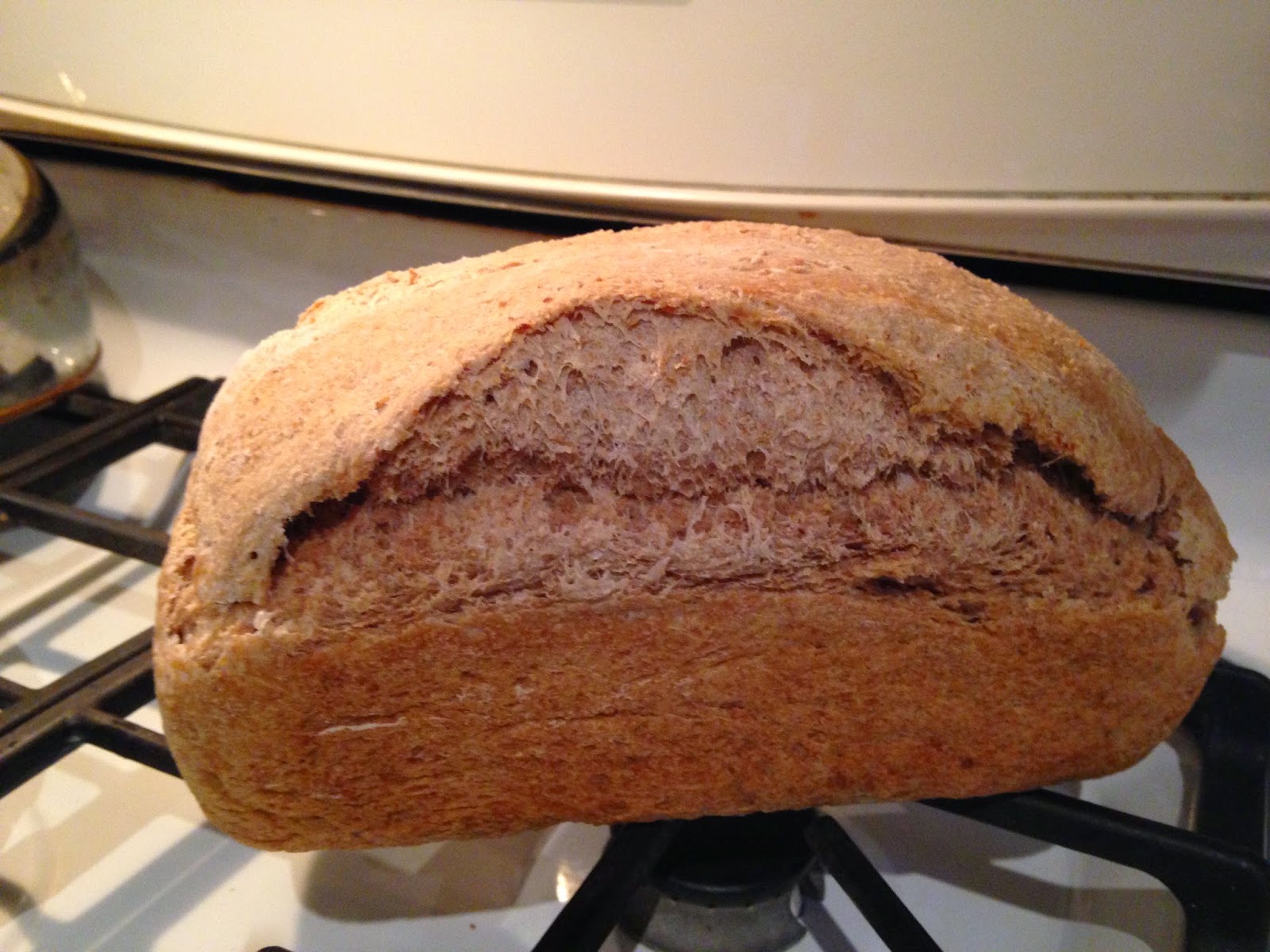
Wow, lots of oven spring. I was afraid I was going to fine a giant hole inside the crust, but no. Nice bread and rose very well. A bit of an unusual taste, as if the kasha softened the crumb. The kasha lends a very subtle taste, so subtle that I would bet no one would ever shout out, "Whoa, a kasha bread!" This bread tasted like a good whole wheat bread, just a bit outside of the ordinary. The appearance is not competition worthy as I failed to make any pretty slashes and allow for the dough's expansion, but a good, wonderful bread that displays my starter's continuing happiness in helping breads to rise.
