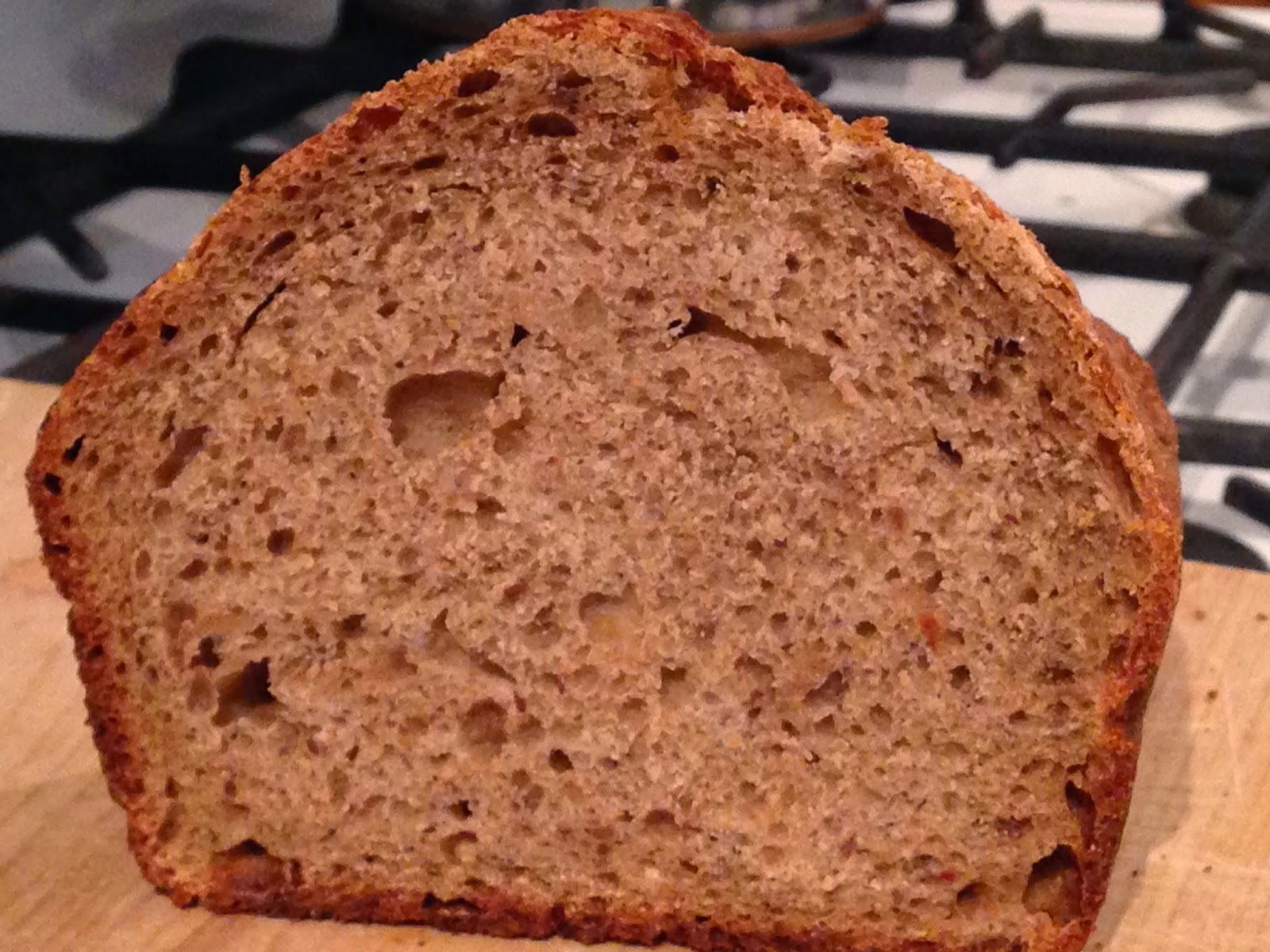
A superb sandwich bread that's also fine just with butter or jam
I was so pleased when I saw the impressive oven spring on this bread because I was a bit unsure whether it had overproofed. Made in a loaf pan, the bread is the appropriate sandwich shape and has a hearty, whole grain taste without being overbearing.
Might be time for a new digital scale
Much as I love a good bargain and a company with a lifetime guarantee, the second go-around with the lower-end Escali scale might be the last. In the past couple of weeks, the scale has gone from a starting point of going back to zero upon request, then upping to 1 to the current situation of going up and up, maybe to six, and then weirdly changing numbers when I take a bit off the top (let's say if I put a bit too much flour in the bowl). Reliability is a necessary feature of a scale and if I cannot trust the numbers, the game is up.

Whatever happened with the numbers, and I hope they are accurate or very close, this bread came out perfectly. I needed a sandwich bread with a comfort-food taste for my daughter, who is recovering from minor surgery (the recovery itself not feeling so minor for a few days). For her, I added a little honey - raw honey - and coconut oil. This dough is majority whole grain with whole wheat flour and flaxseed meal. (I'm not an organic nut case, I also keep regular - yes, farmers market- honey.)
This dough was made with two soakers, though, I suspect, the soakers could have been combined. I also used more starter than usual because I left out a preferment phase and wanted the bread done by early evening on a Sunday, that being my get-into-bed-early night.
Ingredients
There is a table below with the amounts and when each ingredient went in.
Hydration: 70 percent (including starter)
Whole grain: 66 percent
Soaker #1
283g water
360g whole wheat flour
5g salt
Soaker#2
38g water
21g flaxseed meal
I mixed up each of the soakers in separate bowls, covered and let stand on the kitchen counter for about 16 hours.
Dough
both soakers
50g water
107g starter (100 percent hydration. I was aiming for 100 grams, and was uncertain whether I even had enough, when an extra bit plopped out of the jar and into the mixing bowl.)
140g bread flour
10g coconut oil
8g honey (in this case raw, which is solid)
5g salt
Mixing, sitting, stretching, etc.
I mixed the dough ingredients by hand due to the refusal of the flaxseed soaker and the honey to integrate with the other ingredients. And my hands soon held as much dough as the bowl. A messy business. Due to the extreme stickiness and the small amount of dough, I added the bread flour. I also suspected that my daughter would prefer less of an extreme heartiness of totally whole grain bread. During her difficult few days, I wanted the bread to fit comfortably into the category of comfort food. [Photo of bread not taken until more than half eaten.]
After mixing, I let the dough sit, covered, for 10 minutes. I then did three stretch and folds, the first time with a couple of minutes of kneading, each 15 minutes apart. The dough was not nearly as sticky as it had been at first and progressively gathered strength. Keep covered and let the dough rise.
Earlier engagement
Having committed myself to another engagement, I left the dough covered on the counter for 4.75 hours and I was anxious that there would be overproofing. When I returned, the dough was almost flat, with a few tops of larger bubbles just poking above. Well, this is what experimenting is all about, taking the chance of a failure to test where the guideposts actually are.
At 4.75 hours, I did a stretch and fold flat on a well-floured cutting board; then covered and let the dough sit for 15 minutes. At the end of the 15 minutes, I preheated the oven to 460 degrees - for one hour - and put the top of the oblong la cloche in the oven to preheat that as well.
I shaped the dough into a fairly rectangular mass, sprayed the inside of a loaf pan, placed the dough in the pan, and covered it. I let the dough rest for an hour. Yes, I performed the dent test, but I am never certain of those results. I did three nice slashes on top and placed the loaf pan in the oven. I covered the pan with the top of the oblong la cloche; not quite a perfect fit, but it does the job. I would not quickly jerk the oven shelf because the fit of the top of the la cloche on the loaf pan is not what one would call secure.
Voila
I looked at a half hour and may I say, quite impressive oven spring. I was relieved. I kept the top of the oblong la cloche on for the entire baking time of 47 minutes. The taste is excellent and there was eating before I could take photos the next morning. My daughter was pleased.
Nice breads in future
Last weekend, I went on a flour shopping spree and purchased spelt, teff and coconut flours. They are sitting in the freezer, hoping beyond hope to be selected for the next dough. They will have to compete, however, with the current store of whole wheat, arrowroot and the very popular flaxseed meal. I almost bought more rye, as that is always a favorite, but I have made so many rye breads and the newflours deserve a chance. Plus, spelt is an old favorite as well; not forced to go into completely unfamiliar territory. I'm thinking of a spelt and teff combination for the next dough.
Here is the table. Lovely, no?
| INGREDIENT |
SOAKER 1 |
SOAKER 2 |
DOUGH |
TOTAL |
| Water |
283 |
38 |
50 |
371 |
| Whole Wheat Flour |
360 |
|
|
360 |
| Salt |
5 |
|
5 |
10 |
| Flaxseed Meal |
|
21 |
|
21 |
| Starter |
|
|
107 |
107 |
| Bread Flour |
|
|
140 |
140 |
| Coconut
Flour |
|
|
10 |
10 |
| Honey |
|
|
8 |
8 |
P.S. Sean Connery is the quintessential Bond. And Bond drinks martinis, not beer. I won't budge on this.
Top four breads: Like watching a good movie over and over
On the way to making 108 different types of breads I have discovered a few breads that I am making over and over because they taste wonderful and are easy to fit into a working - I spend the day at the office - schedule. These will be so popular that you will receive requests, perhaps even from family and friends who questioned why you would produce your own bread to begin with.
The following recipes all use sourdough starters, which are not complicated to create, maintain or use. I have an easy sourdough primer and links. Some of these bread recipes were adjusted for earlier recipes that I had made with commercial yeast. The sourdough culture has worked so well that I have not used store-bought yeast in almost a year - except for challahs, but that could be changing soon.
My favorite repeats
- drum roll, please ...
Rye bread - No surprise because I am from Brooklyn. You can't do better than a good rye. The New York genes in my children have made the recipe for bread #27 a big favorite.
Whole wheat sandwich bread - The secret ingredient in bread #32, a 100 percent whole wheat bread, is coconut oil. Make in a loaf pan. It is easy to slice.
Spelt bread - I am a spelt lover. It's not just me. Everyone adores breads made from the recipe for bread #34. This 100 percent spelt bread is not heavy at all.
and ... one more drum roll, please ... the new entrant -
White bread - Bread #38 comes out so well every time, is so perfectly matched to a busy schedule, and so amazing with its bubbling sponge and miraculously rising dough that I made it three times in rapid succession. Now I understand why bakers extol the virtues of white flours and white breads. I've already started to make variations on this recipe.
[I have now made a few variations of bread #38 (breads #40 to 42) and whole wheat-dominated variations do well. We did not care so much for the partial spelt variation.]
Celebrating the 40 mark
 For Chanukah, my husband gave me a few bread-related gifts. Perhaps the best one is a 108 breads apron. I feel so established and professional wearing it. Already the apron is another talisman for good fortune in baking. The other gifts were an oblong la cloche, which I must figure out how to use, and a book, the Art of Fermentation, which threatens to turn me into a fermentation maniac. A review soon. Even though it is not a bread book per se, it is related. From a read through, the directions are less than thorough. I like a nice detailed instruction on anything that I have not tried before.
I am contemplating homemade sauerkraut and other fermented vegetables. Brad and I have been talking about a sauerkraut endeavor for over a year. If I het as far as making tempeh at home, I have gone a bit off of the deep end. Of course, it was not all that long ago I felt similarly about growing and maintaining a sourdough culture.
I doubt I will get past the sauerkraut, however, as I do work for a living. Going beyond sauerkraut would mean going into business to teach people and sell the fermented goodies. Something about the word fermented does not go with goodies, unless you are beer lover, but that's a whole other story.
Well, I will have to figure out when to use this lovely new oblong la cloche. My husband gets the first bread made with it, for sure.
For Chanukah, my husband gave me a few bread-related gifts. Perhaps the best one is a 108 breads apron. I feel so established and professional wearing it. Already the apron is another talisman for good fortune in baking. The other gifts were an oblong la cloche, which I must figure out how to use, and a book, the Art of Fermentation, which threatens to turn me into a fermentation maniac. A review soon. Even though it is not a bread book per se, it is related. From a read through, the directions are less than thorough. I like a nice detailed instruction on anything that I have not tried before.
I am contemplating homemade sauerkraut and other fermented vegetables. Brad and I have been talking about a sauerkraut endeavor for over a year. If I het as far as making tempeh at home, I have gone a bit off of the deep end. Of course, it was not all that long ago I felt similarly about growing and maintaining a sourdough culture.
I doubt I will get past the sauerkraut, however, as I do work for a living. Going beyond sauerkraut would mean going into business to teach people and sell the fermented goodies. Something about the word fermented does not go with goodies, unless you are beer lover, but that's a whole other story.
Well, I will have to figure out when to use this lovely new oblong la cloche. My husband gets the first bread made with it, for sure.
Finally, kneading the dough for bread #32, I felt like a baker. My hands were covered in sticky dough; the counter was pasty with it; the scraper was being used frequently to gather stray bits; and the texture of the dough felt magical. With a 20 to 30-minute autolyse, the strands of gluten were nicely developed by the time kneading began and a surprising rendezvous had begun.
Yes, I feel that I strayed from the purist position of flour, water, yeast and salt that I prefer. But there was some familial demand for an easily slice-able sandwich bread. Due to low expectations, I only took pictures after baking. [The photographs of the dough development were taken when I made this bread again.]
With slight, but significant variations, both breads used the Grammy sandwich bread recipe from the Art of Baking with Natural Yeast. The recipe calls for coconut oil and optional honey, which I left out of bread #31 and added to the dough for bread #32. I changed the timing for the recipe as my very warm, DC-area summer kitchen completely changes the equation for rising duration coming from recipes that imagine 65 or 70-degree temperatures.
Spoiler alert: Bread #31 was less than mediocre, while bread #32 was sublime. At the end of this post is a mention of the controversy over coconut oil.
Ingredients and instructions
Autolyse
10 oz. water
12.65 oz. whole wheat or white whole wheat flour (used the latter in bread #32)
Mix, cover, and let rest for 20 minutes. [Photo: At the end of the 20-minute autolyse.]
Dough
Add to autolyse:
1 tbsp coconut oil
1/8 cup = 1 1/2 tbsp honey
1 tbsp starter for bread #31 - 3.5 oz. starter for bread #32 (will explain briefly later)
1 tsp salt
Just put ingredients in order on top of autolyse, except for the salt. I put the salt in last, only after partially mixing, so that the dough would get a little more time before the salt affected the yeast development.
Mixing and kneading
Leave about 10 minutes for mixing by hand as the autolyse takes more strength to mix than a regular dough. Cover the dough and let rest for 10 minutes before kneading. This was added to bread #32 after reading a different book, which will likely be discussed at another time. It is Wild Sourdough. [Photo taken just after the dough is kneaded.]
The dough is gloppy, gloopy and feels a little oily as well from the coconut oil. Knead for 10 minutes or until the windowpane test is satisfied. Wet your hands and the counter a bit. For hand kneading, the dough scraper will be necessary. Be prepared for a mess.
Rising
Due to timing demands so that I would get the bread baked within one day of beginning, I greatly upped the starter content for the second try of this bread. The original recipe calls for 1/4 cup. I tried for an overnight rise the first time with 1 tablespoon of starter and an afternoon bread baking for the second attempt with 3.5 ounces (about 100 grams).
Bread #31
1 tablespoon of starter - 10.25 hours of rising. The overnight rising does not work so well during the summer, when the 15 to 20-degree (Farenheit) difference in temperature dramatically decreases the rising time. Even with using just a fraction of the recommended amount of starter culture, I find I should decrease the starter amount further to get a 10 to 12-hour first rise.
Bread #32
3.5 ounces (about 100 grams) - 3.5 hours of rising, which was perfect
At two hours, just a few bubbles. [Photo to the left on top was taken at two hours. Bubbles must be looked for.]
At three hours, the dough had doubled in volume, though the bubbles were not as apparent as they had been at two and a half hours. [Photo to the left on bottom was taken at three hours. There are more bubbles, with some large and almost bursting.]
At three and a half hours, I was getting anxious about over-rising.
 Shaping
I will skip bread #31 on this and head straight to bread #32. I only did a shaping taking the corners and folding in. Then I did a few swift rounding motions on the counter. I sprayed a loaf pan with non-stick baking spray and put the dough in the pan to rise, covered with plastic.
Shaping
I will skip bread #31 on this and head straight to bread #32. I only did a shaping taking the corners and folding in. Then I did a few swift rounding motions on the counter. I sprayed a loaf pan with non-stick baking spray and put the dough in the pan to rise, covered with plastic.
Recommended rising time was two to two and a half hours, with the suggestion that the dough is sufficiently risen when a poke does not immediately bounce back. Both times, mine seemed ready at two hours. For bread #32, the dough rose remarkably in the loaf pan - coming completely in contact with the plastic at two hours without room for further expansion. Poking was impossible with the dough sticking to my finger. Expectations were low.
Baking
Preheat oven to 375 degrees. Baked bread #32 for 28 minutes. I put the loaf pan on the baking stone. For bread #32, at 25 minutes, the crust still seemed a little light. Three more minutes did the trick. Ten to 15 minutes later, the bread easily same out of the loaf pan. I then let it sit on a rack overnight.
I was not expecting anything from the sticky mass of the dough for bread #32.
(No need to go into details about bread #31, which I baked for 40 minutes and did not go over well with anyone.)
Taste
Bread #32 is a winner with great taste. I expected a wet blob and instead got a wonderful oven spring, great rising, a bread that slices easily and is in the right shape for sandwiches. There is a very slight sweetness and the texture is moist, but not wet.
Coconut oil
The Art of Baking with Natural Yeast claims that coconut oil is very healthy. A brief Internet search finds more complexity. WebMD's page on coconut oil states that there is a lack of data and takes the cautious approach of advising sparing use of this non-saturated, but fat-filled oil. However, there are numerous sites that appear in a Google search that extol the health benefits of coconut oil, with many subsidized through advertising. One representative link discusses benefits for heart, skin and cancer prevention. Supposedly, coconut oil is a favorite with vegans and is used in many healthy population groups. I have performed no independent data collection on this topic.