Now there are two proofs that a divine presence exists in the universe: (1) I have parallel parked (seldom, but it has happened), and (2) a glob of a dough turned into an amazing bread.
I remade bread #76 with changes, making it larger and with some fresh rosemary. I have been working for so long with my standard recipe, with slight variations, that I had forgotten what it is like to babysit a dough and not know when it will be ready. Felt like the parent of a newborn.
Autolyse
501g whole wheat flour
523g water
Mix, cover and let rest for 20 minutes.
Dough
autolyse
100g starter
1g fresh rosemary
11g salt
104 percent hydration makes for a dough, but a wet one.
Let rest for 20 minutes and tried to do two stretch and folds, each 20 minutes apart. Actually ended up kneading for about a minute each time. Let rest to rise, covered, of course.
Anxiety and time pressure
At 3.5 hours I did a slight mix/knead because some liquid had pooled slightly around the edges. At 6.66 hours, the volume of the dough was looking good, much expanded, but not popping of a few large bubbles - think pizza, not sponge or starter bubbles.
Math skills off: I thought I had nine hours to let dough rest, but I had only seven, and dough was being prepared for New Year's Eve dinner party for which husband was whipping up a storm of impressive appetizers, soup, and many dishes. On the plus side, the dough smells heavenly with the freshly ground wheat flour mixed in with the rosemary. Love that fresh rosemary right off the backyard plant. You have to love a plant that thrives without any maintenance whatsoever.
So, at 6.8 hours, did a stretch and fold, though not sure at 104 percent hydration, with wet hands and a goopy, though cohesive, dough, whether one can actually call what I did a stretch and fold.
Moving on blindly
Now we go into uncharted territory.
Toping ingredients:
rice flour
sesame seeds
ground flaxseed (not flaxseed meal)
Start with rice flour and sprinkle generously into a bowl. Rice flour is between you and sticky disaster of a dough that will not come out of the bowl. Then follow with sesame seeds and ground flaxseed. These will add to taste and look lovely. Cover bowl with plastic, beeswax, wet towel, or, in my case, a shower cap that gets reused a million times.
Promise myself NOT to touch dough for 1.25 hours.
Baking
Because dough is quite wet, I decide to use the Dutch oven. AND sprinkle generously with rice flour before putting Dutch oven in the oven. Why? I have never tried this before. Usually I do my sprinkling, if any, of rice flour over a million-degree oven just before placing the dough inside and the Dutch oven gets particularly hot and scary. But I'm in an experimental, though anxious, mood. I know the rice flour will burn, but maybe it will work and save a good 30 seconds of accumulated heat when I plop that dough in the awesomely hot Dutch oven in an hour.
Preheat oven to 480 degrees with Dutch oven - and its rice flour - inside. Wait for an hour.
1. Grammatical tense agreement, as you see, has gone out the window.
2. More anxiety to follow.
I am anxious because I did the rice flour thing in the dough bowl instead of spraying or wiping it with oil. I could have put on sesame seeds and flaxseeds just before baking. Will the dough stick to the bowl like the gloopy mess it could be and not even make it into the oven? What was I thinking? And will the burned rice flour at the bottom of the Dutch oven ruin whatever chances of a good bread?
For the hour of anxiety I do KP duty and attempt to keep up with cleaning of bowls, measuring cups, and other accoutrements of husband's prolific cooking. This will end up making no difference as the next morning I clean up for three hours, which had been preceded by three minutes of wondering how to start and thoughts of never again having a clean kitchen. I must say that the water in the sink the next morning was about as dirty and greasy as an environmentally toxic disaster area.
In theory
Experimentation, innovation, all wonderful in theory, but not safe and when compared to the recipe followers of this world with their known outcomes and their accomplishments of set goals time after time, one can doubt. In fact, doubt is part of all creativity and seeking really. Certainty keeps one in the same hole. Enough philosophy; back to bread.
I was imagining a messy disaster and felt I was merely going through the motions to see how badly this bread would turn out. It was a mess of a dough - no shape. It could not be placed on the counter, shaped, slashes done on top. No, I plopped it, in the purest sense of the term, quite unglamorously into the bottom - really bottom corner, if a circular-shaped bottom can have a corner - of the Dutch oven. I quickly sprinkled some more ground flaxseed and sesame seeds on top, put the top on the Dutch oven, and prayed, but only briefly because this was not going to turn out well.
Baking results - must peek
Baking time: 45 minutes at 480 degrees, the whole time covered with top of Dutch oven so could not peek.
OMG! Miracle! Show tunes practically blasting in the air, though only I am hearing them. A gorgeous, deep brown bread with perfectly sprinkled organic, artisanal stuff on top. This unattractive, unshapen dough was actually the ugly duckling of a later incredible Cinderella of a bread, a perfect dinner party ooh-it's-beautiful-and-delicious-amazing bread. Resorting to mixing fairy tale metaphors inappropriately. Cinderella was always beautiful; she just needed time off, nicer clothes, and definitely a shower.
Kept eating it the next few days as the husband enjoyed his frozen bagels over the winter break. More bread for me. Incredible and must make again. Perhaps anxiety was key ingredient.
Divine bread making spirit in the universe - only half kidding
Received so much more than I deserved unless bread deity believes, like me, that worrying produces good results. Perhaps a kindred spirit. Deity of bread making clearly was smiling upon me with favor. I felt blessed and relieved that dinner party bread did not turn out to be punishment for experimenting. Grace, gratitude, and selfishness.
Taste: Fantastic, amazing, great. Do not want to share.
loaf of bread

Showing posts with label Flaxseed. Show all posts
Showing posts with label Flaxseed. Show all posts
Monday, January 2, 2017

Tuesday, May 26, 2015
Bread Number 77: A Rye/Flaxseed Meal Virtuoso of a Bread
A top pick
If there is a bread that shows I have learned lessons along the way from bread number zero to 77, this one is it. One word: fantastic. Though I started without all of the ingredients in the recipe from Local Breads, and rejected a couple, my instincts paved the way to an utterly delicious and interesting loaf.
 By the way, Daniel Leader, the author of Local Breads, gets a lot of flack in the book reviews about poor editing, inconsistent measures, and bad recipes. One review seemed to sum up the consensus that the book is worthwhile if - and this is perfect for me - the recipes are considered as guides, but not as strict sets of instructions. The reviews also indicated that only the metric weights should be heeded. Another warning was that the bakers percentages are sometimes wholly inaccurate.
Starting point
I read those reviews after making this bread and as I generally do not strictly follow recipes, all was good in modifying the flax, sesame, sunflower seed, rye recipe. I left out the sunflower seeds altogether and I only used sesame seeds sprinkled on top and not incorporated in the dough. I also added a sponge phase, refused the instruction to do a second kneading, and I did not use a rye starter. So perhaps the recipe was more a starting point than a guide.
Total ingredients
331g water
20g starter
210g rye flour
290g bread flour
6g caraway seeds (and a bit more to sprinkle on top)
28g flaxseed meal
10g salt
sesame seeds optional for sprinkling on top
Sponge
101g water
20g starter (all purpose flour, not rye) (Used 50g starter for the second try and adjusted other ingredients accordingly.)
100g rye flour
I juggled the amounts of the ingredients so that I could add a sponge phase and to use as much rye as the 60 percent recipe. I used a small amount of starter due to the very warm night, about 80 degrees in the kitchen. This was my first foray beyond 30 percent rye, perhaps on the way to trying a truly dense rye.
Here we leave the realm of recipe and enter into reality. I was going to let the sponge stay out all night, but I woke up with a start at 2:30 - six hours after making the sponge - and put the sponge in the fridge. The fright took hold that the sponge would be past peak by morning. Once I took it out, and accounting for the warm up delay, the sponge had a bulk fermentation time of 9.5 hours in a pretty warm kitchen. When I made this bread a second time, the dough fermented for about 12 hours, but the kitchen was about 10 degrees cooler.
Dough
230g water
290g bread flour
110g rye flour
28g flaxseed meal
6g caraway seeds (Used 8g the first time, but the caraway might be too overwhelming for some at that amount.)
10g salt
Sesame seeds and caraway seeds - sprinkle on top before baking.
Use what you have
Another departure from the recipe was that I had flaxseed meal and no actual flaxseeds. I used an equal weight and all turned out fine. I also added caraway seeds because I have the misguided notion that it is illegal to make a rye bread without them. That might be the case in Brooklyn. I admit that using a little less caraway for the second try, which was an improvement.
The recipe called for lots of kneading for a rye, so I did half the recommended time. I kneaded for 10 minutes. I also did not add any commercial yeast; the rising time ended up being about two hours longer than recommended. Mine rose for 3.5 hours both times I made this.
Trust your instincts
For about a nanosecond, I followed the recipe instructions instead of my instincts by just starting to sprinkle flour over the wet dough before shaping. A loud voice in my head screamed out "STOP!" as the first glop of dough began to stick to my fingers. Confident that voice was as it continued to instruct using water instead, which worked out much better; no sticking at all. Worked quite well with water the second time around as well.
I sprinkled water on the counter and my hands for a fuss-free shaping and transfer of the dough to a loaf pan. This dough was not going to hold any shape on its own. I also ignored the instructions that this dough should make two loaves and I made one decent-sized, not actually that large, loaf. Cover the loaf pan with plastic, or, in my case, a shower cap.
Baking
 Preheat the oven at 400 degrees for an hour while the dough rests. I also preheated the top of the oblong la cloche because it kind of, sort of fits over the loaf pan. The top of the la cloche keeps the moisture in and, therefore, frees the baker from having to throw water or ice cubes into a pan when the oven is burning hot.
At one hour, the dent test passed as much as is possible with a wet dough, it was time for baking. I sprinkled water on top and then sprinkled sesame and caraway seeds.
 Oven time at 400 degrees was 47 minutes, two of which were uncovered.
For the second go around, I preheated the oven to 450 degrees and immediately reduced the temperature to 400 when the dough went in. Somewhat more oven spring resulted.
 Hello beautiful
Next to the word "gorgeous" in the dictionary should be a photograph of this bread. And taste - amazing. Total agreement on this in the household. A top pick, to be sure.
If there is a bread that shows I have learned lessons along the way from bread number zero to 77, this one is it. One word: fantastic. Though I started without all of the ingredients in the recipe from Local Breads, and rejected a couple, my instincts paved the way to an utterly delicious and interesting loaf.
 By the way, Daniel Leader, the author of Local Breads, gets a lot of flack in the book reviews about poor editing, inconsistent measures, and bad recipes. One review seemed to sum up the consensus that the book is worthwhile if - and this is perfect for me - the recipes are considered as guides, but not as strict sets of instructions. The reviews also indicated that only the metric weights should be heeded. Another warning was that the bakers percentages are sometimes wholly inaccurate.
 Starting point
I read those reviews after making this bread and as I generally do not strictly follow recipes, all was good in modifying the flax, sesame, sunflower seed, rye recipe. I left out the sunflower seeds altogether and I only used sesame seeds sprinkled on top and not incorporated in the dough. I also added a sponge phase, refused the instruction to do a second kneading, and I did not use a rye starter. So perhaps the recipe was more a starting point than a guide.
Total ingredients
331g water
20g starter
210g rye flour
290g bread flour
6g caraway seeds (and a bit more to sprinkle on top)
28g flaxseed meal
10g salt
sesame seeds optional for sprinkling on top
Sponge
101g water
20g starter (all purpose flour, not rye) (Used 50g starter for the second try and adjusted other ingredients accordingly.)
100g rye flour
I juggled the amounts of the ingredients so that I could add a sponge phase and to use as much rye as the 60 percent recipe. I used a small amount of starter due to the very warm night, about 80 degrees in the kitchen. This was my first foray beyond 30 percent rye, perhaps on the way to trying a truly dense rye.
Here we leave the realm of recipe and enter into reality. I was going to let the sponge stay out all night, but I woke up with a start at 2:30 - six hours after making the sponge - and put the sponge in the fridge. The fright took hold that the sponge would be past peak by morning. Once I took it out, and accounting for the warm up delay, the sponge had a bulk fermentation time of 9.5 hours in a pretty warm kitchen. When I made this bread a second time, the dough fermented for about 12 hours, but the kitchen was about 10 degrees cooler.
Dough
230g water
290g bread flour
110g rye flour
28g flaxseed meal
6g caraway seeds (Used 8g the first time, but the caraway might be too overwhelming for some at that amount.)
10g salt
Sesame seeds and caraway seeds - sprinkle on top before baking.
Use what you have
Another departure from the recipe was that I had flaxseed meal and no actual flaxseeds. I used an equal weight and all turned out fine. I also added caraway seeds because I have the misguided notion that it is illegal to make a rye bread without them. That might be the case in Brooklyn. I admit that using a little less caraway for the second try, which was an improvement.
The recipe called for lots of kneading for a rye, so I did half the recommended time. I kneaded for 10 minutes. I also did not add any commercial yeast; the rising time ended up being about two hours longer than recommended. Mine rose for 3.5 hours both times I made this.
Trust your instincts
For about a nanosecond, I followed the recipe instructions instead of my instincts by just starting to sprinkle flour over the wet dough before shaping. A loud voice in my head screamed out "STOP!" as the first glop of dough began to stick to my fingers. Confident that voice was as it continued to instruct using water instead, which worked out much better; no sticking at all. Worked quite well with water the second time around as well.
I sprinkled water on the counter and my hands for a fuss-free shaping and transfer of the dough to a loaf pan. This dough was not going to hold any shape on its own. I also ignored the instructions that this dough should make two loaves and I made one decent-sized, not actually that large, loaf. Cover the loaf pan with plastic, or, in my case, a shower cap.
Baking

At one hour, the dent test passed as much as is possible with a wet dough, it was time for baking. I sprinkled water on top and then sprinkled sesame and caraway seeds.

For the second go around, I preheated the oven to 450 degrees and immediately reduced the temperature to 400 when the dough went in. Somewhat more oven spring resulted.

Next to the word "gorgeous" in the dictionary should be a photograph of this bread. And taste - amazing. Total agreement on this in the household. A top pick, to be sure.
Wednesday, February 25, 2015
Bread Number 70: Celebrating with Beer - in Dough and Otherwise
Just pour the bottle into the bowl
So weird to actually open the beer bottle, in this case, Brooklyn lager, and just empty it right into the dough bowl. Great smell.
Maybe it was the beer that explains why this dough rose so slowly, or perhaps, it was my unwise use of a just-fed starter instead of having the patience to wait to make the dough until the starter was ripe. Definitely, the cold winter temperatures contributed to the slow rise as well, a total of 27 hours. Mind-blowing, yes, and a testament to my ability to be patient, at least on occasion.
 Beer is welcome as a fun way to experiment as I approach the final third of the 108-bread project. Will also taste good to eat the beer bread with beer. I drink about one to two beers a year. An exact level of thirstiness is necessary; somehow, wine requires no such limitations. Of course, for those for whom any beer will do, this might seem like an alien attitude.
Two more breads - number 72 - until I hit the two-thirds mark. My daughter tells me to plan a celebration for 108 and immediately a party at a bakery or a bakery tour come to mind, closely followed by the idea of a bread-maker gathering. Or maybe just a quiet breakfast of homemade bread, nice tea or coffee, and some fine music, Sinatra, perhaps, and something good to read. I like my bread that way.
Ingredients and instructions
352g beer
70g starter (120 percent hydration, with big qualification; details below)
100g whole wheat flour
16g flaxseed meal
20g rye flour
389g bread flour
11g salt
Autolyse
Mixed all flours, flaxseed meal and beer (love writing that word in this context), covered, and let sit for 30 minutes.
Dough
Added starter and salt. Mixed and covered. Did two stretch and folds, the first at 15 minutes and the second another 15 minutes later. Covered and left out overnight.
This was Oscar night, which I totally enjoy. Two reasons: Commenting on dresses and listening to thank you speeches. Warms my heart to hear appreciation for parents, spouses, and opportunities, as well as curiosity about what political outbursts celebrities will engage in. Since I do not read People or pay much attention to celebrity culture, the Academy Awards is the perfect dose.
Starter and long, long rise
Though this recipe includes a healthy amount of starter, 70 grams, I do believe the exceptionally long rise of 27 hours was partly due to the state of the starter and not only to the winter temperatures. Instead of feeding the starter and waiting for it to get all exuberant again, I began with impatience. I fed the starter, adjusting it to a pretty high hydration percentage - estimating 120 percent - and put the almost just-fed starter into the dough. I waited only a half hour in a 65-degree kitchen.
I thought the rise would occur overnight because the outdoor temperatures had increased considerably; we were up to the 30s or 40s. I suppose, however, that the kitchen was nearly as cold as ever in the wee hours. By morning, the dough had hardly expanded. I went off to work, leaving the dough in the heated kitchen, with adult offspring in the house. Called this adult, who sweetly tolerated her mother, and texted a picture of the dough. It needed more time, so I took the chance that the hours would be too many until I returned home from work and asked for the dough to be left out.
 Kitchen heat turned off, then six hours later, turned on for the evening. Returned home, immediately checked dough, but did not look fully ready to cease bulk fermentation. Left dough out until bedtime and then put it in my heated closet. As I was bringing the bowl through the bedroom, spouse noted my increasing bread craziness. Woke up at 12:30 a.m., and carried the dough to the refrigerator. Finally, it appeared ready, but this was not my time to move on to the next phase.
Tending to the dough
The next morning, I shaped the dough, without even a stretch and fold. Placed the dough on a well-floured kitchen towel and put it in a small wicker basket. Covered and left in fridge for 12 hours.
Returned home from work and preheated oven, with top of la cloche and baking stone inside, to 500 degrees for one hour. I took the dough out of the fridge immediately prior to baking, stopping only to put a nice set of cross slashes into the top of the dough.
 Baking
Left the temperature at 500 for 20 minutes, then reduced to 470 degrees. Total baking time, 51 minutes. Lovely oven rise that only a majority white bread flour dough will produce. Divine crackling sound emanating, hissing practically, from the just-done bread.
Incredible, great taste with a hint of the beer. I never would be able to identify the beer taste if I did not know there was beer in the bread, but the taste had a different twang than a long rise sourdough - a more complex, maybe a two-layered, twangi-ness. And twangy is not a technical term, yet.
Next up: plan to eat the bread with beer: A big yum, I'm sure.
So weird to actually open the beer bottle, in this case, Brooklyn lager, and just empty it right into the dough bowl. Great smell.
Maybe it was the beer that explains why this dough rose so slowly, or perhaps, it was my unwise use of a just-fed starter instead of having the patience to wait to make the dough until the starter was ripe. Definitely, the cold winter temperatures contributed to the slow rise as well, a total of 27 hours. Mind-blowing, yes, and a testament to my ability to be patient, at least on occasion.
Two more breads - number 72 - until I hit the two-thirds mark. My daughter tells me to plan a celebration for 108 and immediately a party at a bakery or a bakery tour come to mind, closely followed by the idea of a bread-maker gathering. Or maybe just a quiet breakfast of homemade bread, nice tea or coffee, and some fine music, Sinatra, perhaps, and something good to read. I like my bread that way.
Ingredients and instructions
352g beer
70g starter (120 percent hydration, with big qualification; details below)
100g whole wheat flour
16g flaxseed meal
20g rye flour
389g bread flour
11g salt
Autolyse
Mixed all flours, flaxseed meal and beer (love writing that word in this context), covered, and let sit for 30 minutes.
Dough
Added starter and salt. Mixed and covered. Did two stretch and folds, the first at 15 minutes and the second another 15 minutes later. Covered and left out overnight.
This was Oscar night, which I totally enjoy. Two reasons: Commenting on dresses and listening to thank you speeches. Warms my heart to hear appreciation for parents, spouses, and opportunities, as well as curiosity about what political outbursts celebrities will engage in. Since I do not read People or pay much attention to celebrity culture, the Academy Awards is the perfect dose.
Starter and long, long rise
Though this recipe includes a healthy amount of starter, 70 grams, I do believe the exceptionally long rise of 27 hours was partly due to the state of the starter and not only to the winter temperatures. Instead of feeding the starter and waiting for it to get all exuberant again, I began with impatience. I fed the starter, adjusting it to a pretty high hydration percentage - estimating 120 percent - and put the almost just-fed starter into the dough. I waited only a half hour in a 65-degree kitchen.
I thought the rise would occur overnight because the outdoor temperatures had increased considerably; we were up to the 30s or 40s. I suppose, however, that the kitchen was nearly as cold as ever in the wee hours. By morning, the dough had hardly expanded. I went off to work, leaving the dough in the heated kitchen, with adult offspring in the house. Called this adult, who sweetly tolerated her mother, and texted a picture of the dough. It needed more time, so I took the chance that the hours would be too many until I returned home from work and asked for the dough to be left out.
Kitchen heat turned off, then six hours later, turned on for the evening. Returned home, immediately checked dough, but did not look fully ready to cease bulk fermentation. Left dough out until bedtime and then put it in my heated closet. As I was bringing the bowl through the bedroom, spouse noted my increasing bread craziness. Woke up at 12:30 a.m., and carried the dough to the refrigerator. Finally, it appeared ready, but this was not my time to move on to the next phase.Tending to the dough
The next morning, I shaped the dough, without even a stretch and fold. Placed the dough on a well-floured kitchen towel and put it in a small wicker basket. Covered and left in fridge for 12 hours.
Returned home from work and preheated oven, with top of la cloche and baking stone inside, to 500 degrees for one hour. I took the dough out of the fridge immediately prior to baking, stopping only to put a nice set of cross slashes into the top of the dough.
Left the temperature at 500 for 20 minutes, then reduced to 470 degrees. Total baking time, 51 minutes. Lovely oven rise that only a majority white bread flour dough will produce. Divine crackling sound emanating, hissing practically, from the just-done bread.
Incredible, great taste with a hint of the beer. I never would be able to identify the beer taste if I did not know there was beer in the bread, but the taste had a different twang than a long rise sourdough - a more complex, maybe a two-layered, twangi-ness. And twangy is not a technical term, yet.
Next up: plan to eat the bread with beer: A big yum, I'm sure.
Monday, February 9, 2015
Bread Number 67: Superb Whole Grain Sandwich Loaf
A superb sandwich bread that's also fine just with butter or jam
I was so pleased when I saw the impressive oven spring on this bread because I was a bit unsure whether it had overproofed. Made in a loaf pan, the bread is the appropriate sandwich shape and has a hearty, whole grain taste without being overbearing.
Might be time for a new digital scale
Much as I love a good bargain and a company with a lifetime guarantee, the second go-around with the lower-end Escali scale might be the last. In the past couple of weeks, the scale has gone from a starting point of going back to zero upon request, then upping to 1 to the current situation of going up and up, maybe to six, and then weirdly changing numbers when I take a bit off the top (let's say if I put a bit too much flour in the bowl). Reliability is a necessary feature of a scale and if I cannot trust the numbers, the game is up.
 Whatever happened with the numbers, and I hope they are accurate or very close, this bread came out perfectly. I needed a sandwich bread with a comfort-food taste for my daughter, who is recovering from minor surgery (the recovery itself not feeling so minor for a few days). For her, I added a little honey - raw honey - and coconut oil. This dough is majority whole grain with whole wheat flour and flaxseed meal. (I'm not an organic nut case, I also keep regular - yes, farmers market- honey.)
This dough was made with two soakers, though, I suspect, the soakers could have been combined. I also used more starter than usual because I left out a preferment phase and wanted the bread done by early evening on a Sunday, that being my get-into-bed-early night.
Ingredients
There is a table below with the amounts and when each ingredient went in.
Hydration: 70 percent (including starter)
Whole grain: 66 percent
Soaker #1
283g water
360g whole wheat flour
5g salt
Soaker#2
38g water
21g flaxseed meal
I mixed up each of the soakers in separate bowls, covered and let stand on the kitchen counter for about 16 hours.
Dough
both soakers
50g water
107g starter (100 percent hydration. I was aiming for 100 grams, and was uncertain whether I even had enough, when an extra bit plopped out of the jar and into the mixing bowl.)
140g bread flour
10g coconut oil
8g honey (in this case raw, which is solid)
5g salt
Mixing, sitting, stretching, etc.
 I mixed the dough ingredients by hand due to the refusal of the flaxseed soaker and the honey to integrate with the other ingredients. And my hands soon held as much dough as the bowl. A messy business. Due to the extreme stickiness and the small amount of dough, I added the bread flour. I also suspected that my daughter would prefer less of an extreme heartiness of totally whole grain bread. During her difficult few days, I wanted the bread to fit comfortably into the category of comfort food. [Photo of bread not taken until more than half eaten.]
After mixing, I let the dough sit, covered, for 10 minutes. I then did three stretch and folds, the first time with a couple of minutes of kneading, each 15 minutes apart. The dough was not nearly as sticky as it had been at first and progressively gathered strength. Keep covered and let the dough rise.
Earlier engagement
Having committed myself to another engagement, I left the dough covered on the counter for 4.75 hours and I was anxious that there would be overproofing. When I returned, the dough was almost flat, with a few tops of larger bubbles just poking above. Well, this is what experimenting is all about, taking the chance of a failure to test where the guideposts actually are.
 At 4.75 hours, I did a stretch and fold flat on a well-floured cutting board; then covered and let the dough sit for 15 minutes. At the end of the 15 minutes, I preheated the oven to 460 degrees - for one hour - and put the top of the oblong la cloche in the oven to preheat that as well.
I shaped the dough into a fairly rectangular mass, sprayed the inside of a loaf pan, placed the dough in the pan, and covered it. I let the dough rest for an hour. Yes, I performed the dent test, but I am never certain of those results. I did three nice slashes on top and placed the loaf pan in the oven. I covered the pan with the top of the oblong la cloche; not quite a perfect fit, but it does the job. I would not quickly jerk the oven shelf because the fit of the top of the la cloche on the loaf pan is not what one would call secure.
Voila
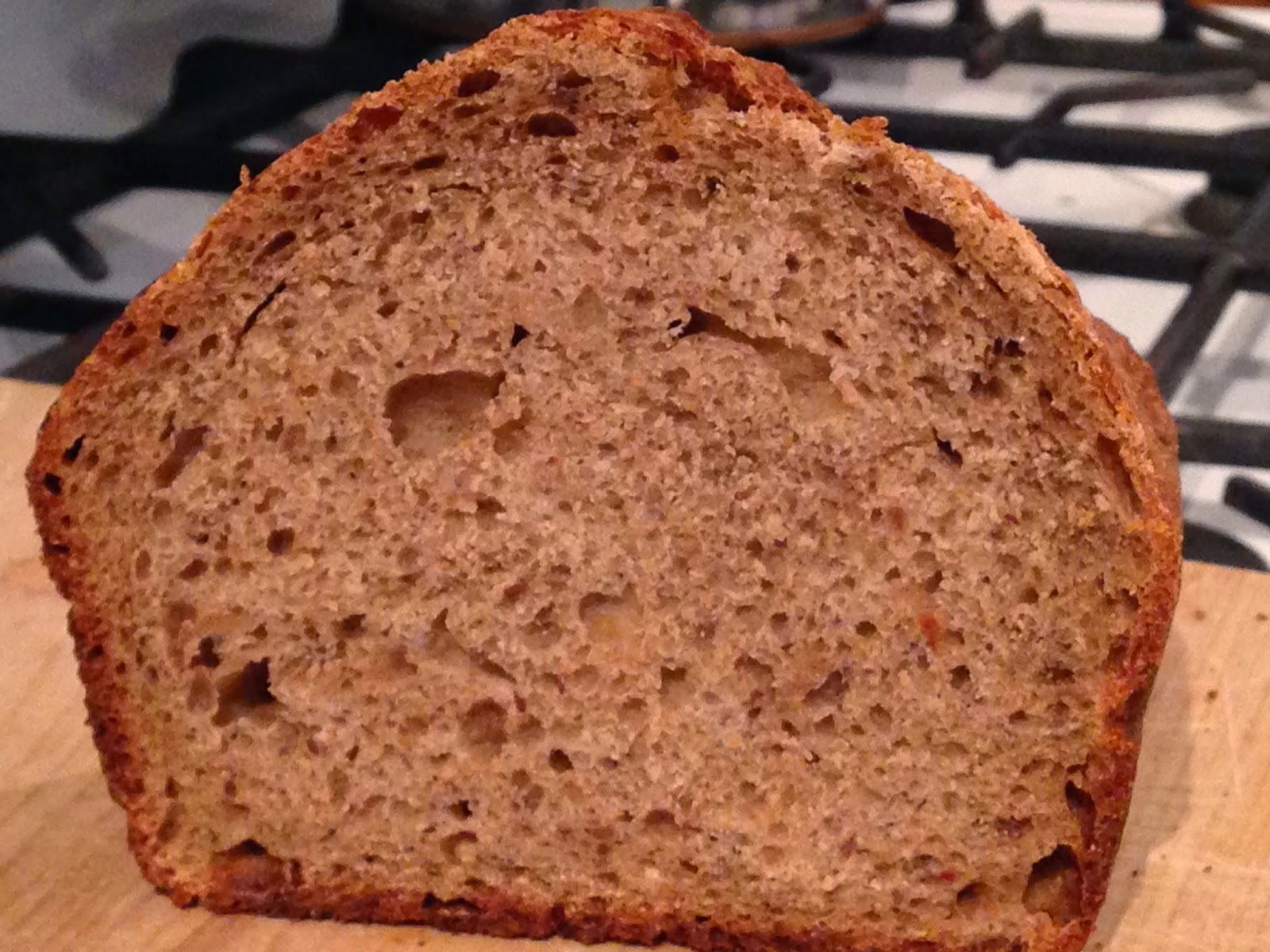 I looked at a half hour and may I say, quite impressive oven spring. I was relieved. I kept the top of the oblong la cloche on for the entire baking time of 47 minutes. The taste is excellent and there was eating before I could take photos the next morning. My daughter was pleased.
Nice breads in future
Last weekend, I went on a flour shopping spree and purchased spelt, teff and coconut flours. They are sitting in the freezer, hoping beyond hope to be selected for the next dough. They will have to compete, however, with the current store of whole wheat, arrowroot and the very popular flaxseed meal. I almost bought more rye, as that is always a favorite, but I have made so many rye breads and the newflours deserve a chance. Plus, spelt is an old favorite as well; not forced to go into completely unfamiliar territory. I'm thinking of a spelt and teff combination for the next dough.
Here is the table. Lovely, no?
P.S. Sean Connery is the quintessential Bond. And Bond drinks martinis, not beer. I won't budge on this.
I was so pleased when I saw the impressive oven spring on this bread because I was a bit unsure whether it had overproofed. Made in a loaf pan, the bread is the appropriate sandwich shape and has a hearty, whole grain taste without being overbearing.
Might be time for a new digital scale
Much as I love a good bargain and a company with a lifetime guarantee, the second go-around with the lower-end Escali scale might be the last. In the past couple of weeks, the scale has gone from a starting point of going back to zero upon request, then upping to 1 to the current situation of going up and up, maybe to six, and then weirdly changing numbers when I take a bit off the top (let's say if I put a bit too much flour in the bowl). Reliability is a necessary feature of a scale and if I cannot trust the numbers, the game is up.
This dough was made with two soakers, though, I suspect, the soakers could have been combined. I also used more starter than usual because I left out a preferment phase and wanted the bread done by early evening on a Sunday, that being my get-into-bed-early night.
Ingredients
There is a table below with the amounts and when each ingredient went in.
Hydration: 70 percent (including starter)
Whole grain: 66 percent
Soaker #1
283g water
360g whole wheat flour
5g salt
Soaker#2
38g water
21g flaxseed meal
I mixed up each of the soakers in separate bowls, covered and let stand on the kitchen counter for about 16 hours.
Dough
both soakers
50g water
107g starter (100 percent hydration. I was aiming for 100 grams, and was uncertain whether I even had enough, when an extra bit plopped out of the jar and into the mixing bowl.)
140g bread flour
10g coconut oil
8g honey (in this case raw, which is solid)
5g salt
Mixing, sitting, stretching, etc.
After mixing, I let the dough sit, covered, for 10 minutes. I then did three stretch and folds, the first time with a couple of minutes of kneading, each 15 minutes apart. The dough was not nearly as sticky as it had been at first and progressively gathered strength. Keep covered and let the dough rise.
Earlier engagement
Having committed myself to another engagement, I left the dough covered on the counter for 4.75 hours and I was anxious that there would be overproofing. When I returned, the dough was almost flat, with a few tops of larger bubbles just poking above. Well, this is what experimenting is all about, taking the chance of a failure to test where the guideposts actually are.
I shaped the dough into a fairly rectangular mass, sprayed the inside of a loaf pan, placed the dough in the pan, and covered it. I let the dough rest for an hour. Yes, I performed the dent test, but I am never certain of those results. I did three nice slashes on top and placed the loaf pan in the oven. I covered the pan with the top of the oblong la cloche; not quite a perfect fit, but it does the job. I would not quickly jerk the oven shelf because the fit of the top of the la cloche on the loaf pan is not what one would call secure.
Voila
Nice breads in future
Last weekend, I went on a flour shopping spree and purchased spelt, teff and coconut flours. They are sitting in the freezer, hoping beyond hope to be selected for the next dough. They will have to compete, however, with the current store of whole wheat, arrowroot and the very popular flaxseed meal. I almost bought more rye, as that is always a favorite, but I have made so many rye breads and the newflours deserve a chance. Plus, spelt is an old favorite as well; not forced to go into completely unfamiliar territory. I'm thinking of a spelt and teff combination for the next dough.
Here is the table. Lovely, no?
| INGREDIENT | SOAKER 1 | SOAKER 2 | DOUGH | TOTAL |
| Water | 283 | 38 | 50 | 371 |
| Whole Wheat Flour | 360 | 360 | ||
| Salt | 5 | 5 | 10 | |
| Flaxseed Meal | 21 | 21 | ||
| Starter | 107 | 107 | ||
| Bread Flour | 140 | 140 | ||
| Coconut Flour | 10 | 10 | ||
| Honey | 8 | 8 |
P.S. Sean Connery is the quintessential Bond. And Bond drinks martinis, not beer. I won't budge on this.
Wednesday, January 28, 2015
Bread Number 66: Wonderful Melange of Flavors
Update below!
So important: No tragedy resulted from a violation of my personal no-bread-making-activity-before-5-a.m. rule.
 Flaxseed, whole wheat and arrowroot with sponge, soaker and long preferment - sounds much more difficult than it is. Basically, there's 20 minutes of weighing and mixing one day and either the next day or that evening another 10 to 15 minutes; then maybe a total of another minute prior to baking. This might be a bit of an exaggeration. Still ... Easy, but impressive, delicious and beautiful. [Photos are of my hometown of Brooklyn, NY and bread #66.]
I mixed up the soaker and the sponge for an overnight rest. The next day, mix the two, add a few more ingredients, do some stretching and folding, and put in the fridge if you have an actual life to attend to. When you decide to bake, once the oven is preheated and the dough is shaped, you are done. A dough that leaves plenty of time to go out to the diner with the spouse, and even say yes when he presses to go shopping for those kitchen cabinets you said you would find, because the whole kitchen project seems to have embedded different time lines and senses of priority in our brains.
 I made this bread twice as my digital scale is acting peevish, making me wonder if it is either having hiccups or preparing itself for permanent retirement.
Everything in grams
Is that not a gorgeous table? So neat, so clear about which ingredient was added and when. Such a visual representation. How sad, it was not saved with its cheery orange lines. That's what made it gorgeous. In case the table is not one's preferred format, the ingredients are listed at the end of this post.
Actual information
Okay, that's an 80 percent hydration dough. The table does not include the unweighed sprinkling of sesame seeds on top just before baking. I should also say that I used the same Danish whisk, uncleaned in between sponge and soaker, so that the soaker would get a wee head start on fermentation, which it did. Not much as there was salt in the soaker.
 Always remember to cover the bowl. I used shower caps to cover the bowls of soaker, sponge and the dough. The shower caps can be cleaned and are reusable.
4 a.m. and no mishaps
The soaker and sponge were made at 4 a.m. I put the heat up in the kitchen early so that they would be ready to be mixed into a dough about mid-day. Yes, I could have mixed up the soaker and sponge the night before, but I got lazy in the evening and we had a nice gathering until late with the spouse's colleagues from the office.
The only difference between the first and second tries of this bread was in the amount of starter, which I accounted for in adjusting slightly the bread flour and water amounts. The activity of the dough and the eventual bread all turned out the same.
Resting, mixing, and so on
9.75 hours for the soaker and sponge to rest. Mixed up the dough and did three stretch and folds, plus a couple of minutes of kneading, every 15 minutes. Let rest for thereafter for 3.5 hours. I admit I started out with only 40 grams of bread flour to add to the final dough, but added more right away, then 20 grams with each stretch and fold, because the dough was so sticky. About what I did the first time before the digital scale had a tantrum and would not permit further weighing. Fortunately, it came back to life with the next bread.

At the end of 3.5 hours, my brain turned off due to the 4 a.m. wake up. I could not decide what to do with the sticky dough that had risen nicely. Shape and put on a floured towel in a bowl? Put in an oiled bowl? A loaf pan? I procrastinated. Just shoved the dough bowl, with its shower cap cover, into the fridge.
I only left the dough in the refrigerator for a couple of hours. My husband asked if we were going to have fresh bread for Monday morning and I suddenly remembered - OMG, time to get ready to bake before the brain shuts off for the evening. A 4 a.m. wake up does not bode well for nighttime thinking.[Photo of the door to Mile End Deli. Great chopped liver and I'm a vegetarian. Still, could not resist when it was made with schmatlz.]
Baking
Preheat oven for one hour at 470 degrees with dutch oven inside.
 I removed the dough bowl from the fridge and lightly, perhaps not so lightly, sprinkled flour on top and underneath all around the dough, to prevent utter stickiness. I shaped the dough quickly, sprinkled on sesame seeds and did three slashes on top. I put my floured hands underneath the dough and pretty much dropped it into the dutch oven. I remembered to put back on the oven mitts before placing the lid on the dutch oven for baking.
Try not to be nervous, but rather achieve a sense of calm, when removing the top of the dutch oven prior to placing the dough inside, and then when plopping the dough in the dutch oven. I use oven mitts and a kitchen towel. Super hot.
Total baking time of 45 minutes; I removed the top of the dutch oven at 30 minutes. Kudos to my thermometer for telling me when the bread was actually fully baked as it looked lovely way too early to be taken out of the oven. Beautiful brown bread and so, so good. This is why I learned to make bread. Yum-mmmmm-y.

Here's the promised list of ingredients
Totals for all ingredients
Water - 372g
Bread flour - 180g
Starter - 100g (82g on the first try, with adjustments elsewhere)
Whole wheat flour - 174g
Flaxseed Meal - 47g
Arrowroot flour - 69g
Salt - 10g
Ingredients listed in order of appearance for each phase.

Sponge
100g starter
100g water
100g bread flour
Soaker
174g whole wheat flour
47g flaxseed meal
224g water
5g salt (Don't sweat this. The last time I mistakenly added 6g and then only 4g to the final dough. That goes for almost any ingredient and life in general.)
Dough
Soaker
Sponge
69g arrowroot flour
 80g bread flour (Added 40g initially, and 20g each at points thereafter in an effort to reduce stickiness - or, for those accustomed to more technical terms, hydration.)
5g salt
Update - Made this one again, a little differently
I took out the arrowroot flour, substituted cornmeal and increased the whole wheat flour share just a bit. Also added sesame seeds on top. At 475 degrees, the bread took 40 minutes to bake in the dutch oven. Totally great.
So important: No tragedy resulted from a violation of my personal no-bread-making-activity-before-5-a.m. rule.
I mixed up the soaker and the sponge for an overnight rest. The next day, mix the two, add a few more ingredients, do some stretching and folding, and put in the fridge if you have an actual life to attend to. When you decide to bake, once the oven is preheated and the dough is shaped, you are done. A dough that leaves plenty of time to go out to the diner with the spouse, and even say yes when he presses to go shopping for those kitchen cabinets you said you would find, because the whole kitchen project seems to have embedded different time lines and senses of priority in our brains.
I made this bread twice as my digital scale is acting peevish, making me wonder if it is either having hiccups or preparing itself for permanent retirement.Everything in grams
| INGREDIENTS | SPONGE | SOAKER | DOUGH | TOTALS |
| Water | 100 | 224 | 48 | 372 |
| Starter | 100 | 100 | ||
| Bread flour | 100 | 80 | 180 | |
| Whole Wheat flour | 174 | 174 | ||
| Flaxseed meal | 47 | 47 | ||
| Salt | 5 | 5 | 10 | |
| Arrowroot flour | 69 | 69 |
Is that not a gorgeous table? So neat, so clear about which ingredient was added and when. Such a visual representation. How sad, it was not saved with its cheery orange lines. That's what made it gorgeous. In case the table is not one's preferred format, the ingredients are listed at the end of this post.
Actual information
Okay, that's an 80 percent hydration dough. The table does not include the unweighed sprinkling of sesame seeds on top just before baking. I should also say that I used the same Danish whisk, uncleaned in between sponge and soaker, so that the soaker would get a wee head start on fermentation, which it did. Not much as there was salt in the soaker.
Always remember to cover the bowl. I used shower caps to cover the bowls of soaker, sponge and the dough. The shower caps can be cleaned and are reusable.4 a.m. and no mishaps
The soaker and sponge were made at 4 a.m. I put the heat up in the kitchen early so that they would be ready to be mixed into a dough about mid-day. Yes, I could have mixed up the soaker and sponge the night before, but I got lazy in the evening and we had a nice gathering until late with the spouse's colleagues from the office.
The only difference between the first and second tries of this bread was in the amount of starter, which I accounted for in adjusting slightly the bread flour and water amounts. The activity of the dough and the eventual bread all turned out the same.
Resting, mixing, and so on
9.75 hours for the soaker and sponge to rest. Mixed up the dough and did three stretch and folds, plus a couple of minutes of kneading, every 15 minutes. Let rest for thereafter for 3.5 hours. I admit I started out with only 40 grams of bread flour to add to the final dough, but added more right away, then 20 grams with each stretch and fold, because the dough was so sticky. About what I did the first time before the digital scale had a tantrum and would not permit further weighing. Fortunately, it came back to life with the next bread.
At the end of 3.5 hours, my brain turned off due to the 4 a.m. wake up. I could not decide what to do with the sticky dough that had risen nicely. Shape and put on a floured towel in a bowl? Put in an oiled bowl? A loaf pan? I procrastinated. Just shoved the dough bowl, with its shower cap cover, into the fridge.
I only left the dough in the refrigerator for a couple of hours. My husband asked if we were going to have fresh bread for Monday morning and I suddenly remembered - OMG, time to get ready to bake before the brain shuts off for the evening. A 4 a.m. wake up does not bode well for nighttime thinking.[Photo of the door to Mile End Deli. Great chopped liver and I'm a vegetarian. Still, could not resist when it was made with schmatlz.]
Baking
Preheat oven for one hour at 470 degrees with dutch oven inside.
I removed the dough bowl from the fridge and lightly, perhaps not so lightly, sprinkled flour on top and underneath all around the dough, to prevent utter stickiness. I shaped the dough quickly, sprinkled on sesame seeds and did three slashes on top. I put my floured hands underneath the dough and pretty much dropped it into the dutch oven. I remembered to put back on the oven mitts before placing the lid on the dutch oven for baking. Try not to be nervous, but rather achieve a sense of calm, when removing the top of the dutch oven prior to placing the dough inside, and then when plopping the dough in the dutch oven. I use oven mitts and a kitchen towel. Super hot.
Total baking time of 45 minutes; I removed the top of the dutch oven at 30 minutes. Kudos to my thermometer for telling me when the bread was actually fully baked as it looked lovely way too early to be taken out of the oven. Beautiful brown bread and so, so good. This is why I learned to make bread. Yum-mmmmm-y.
Here's the promised list of ingredients
Totals for all ingredients
Water - 372g
Bread flour - 180g
Starter - 100g (82g on the first try, with adjustments elsewhere)
Whole wheat flour - 174g
Flaxseed Meal - 47g
Arrowroot flour - 69g
Salt - 10g
Ingredients listed in order of appearance for each phase.
Sponge
100g starter
100g water
100g bread flour
Soaker
174g whole wheat flour
47g flaxseed meal
224g water
5g salt (Don't sweat this. The last time I mistakenly added 6g and then only 4g to the final dough. That goes for almost any ingredient and life in general.)
Dough
Soaker
Sponge
69g arrowroot flour
80g bread flour (Added 40g initially, and 20g each at points thereafter in an effort to reduce stickiness - or, for those accustomed to more technical terms, hydration.) 5g salt
Update - Made this one again, a little differently
I took out the arrowroot flour, substituted cornmeal and increased the whole wheat flour share just a bit. Also added sesame seeds on top. At 475 degrees, the bread took 40 minutes to bake in the dutch oven. Totally great.
Subscribe to:
Posts (Atom)