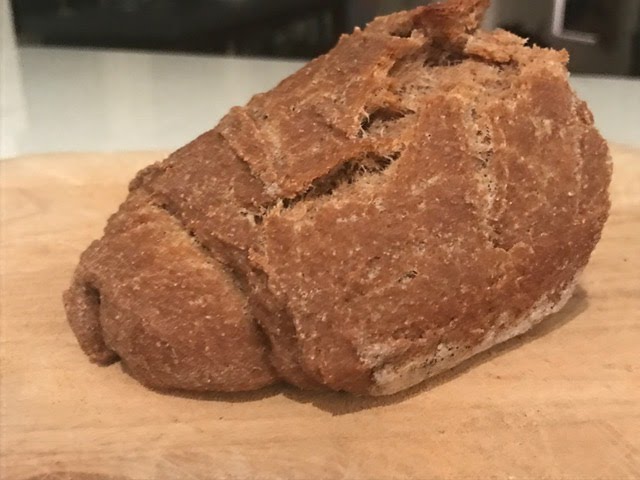
It is true that I am unable to follow anyone else's recipe except for my sister's challah recipe. Bread #95 bread is roughly the Reinhart recipe of a 100 percent whole wheat sandwich bread, but with the significant differences of using sourdough starter and changing the timing due to real-life needs to leave the house and to sleep occasionally. I've now made it twice and it had lovely oven spring each time. The first try was immediately frozen for offspring to eat healthy-bread-from-Mom.
I managed to make multiple breads for the offspring before they left the nest following their winter vacations. I have also discovered another local bread soulmate, who has furnished me with some challah recipes, one sourdough, and what looks like a nice rye.
Not a quick bread
This bread is at least a two-day affair because it involves a soaker, a biga, and running out to the store for yogurt when you find that you ran out. A biga is basically a dough-like pre-dough, more solid than a sponge, and a soaker allows flour to sit in a moistened state, with some salt, anywhere from overnight to a few days. This is similar to an autolyse, except for the much longer duration and the salt. I used a full-fat yogurt with part of the layer of cream that sits on top. It's also grass-fed and I am sure the happy cows were well brought up and were educated at highly-esteemed cow/cattle institutions of higher bovine learning. (You need to watch the early Portlandia episode to get that joke completely.)
Ingredients and instructions
Soaker
226g whole wheat flour
5g salt
198g yogurt (mine was not watery)
Mix well and do not add water, milk, or more yogurt until finished mixing. This pre-dough will appear dry, but do not worry, the liquid is most likely sufficient. Cover bowl after mixing and leave on counter. I left mine out for almost nine hours, but you have up to 24 according to Reinhart's recipe.
Biga
229g whole wheat flour
100g starter (mine is part whole wheat at this point)
160g water
Mix and cover. The instructions call for a prolonged refrigeration, but I wanted it to proceed that evening, so I only put it in the fridge for about five hours and then left it on the counter in a warm kitchen for another two.
Dough
Soaker
Biga
14g coconut oil - melted (Trust me, I did not melt it the first time and the second try went much better.)
10g honey
6g salt
I mixed and then let the dough sit for five minutes, at which point I kneaded for two minutes and did a stretch and fold. I have little patience for kneading. Perhaps I have to listen to better music or have something to watch on TV. I did three more stretch and folds at half hour intervals. Then, the hour being late, I covered the dough and put it in the fridge for 23 hours.
Baking preparation
FYI: This bread gets baked at a rather low temperature and takes relatively long to bake. Preheat the oven to only 425 degrees. I preheated with the oblong la cloche inside so that I could get a longer, thinner shape, though not nearly a baguette.
I also have been trying putting rice flour inside BEFORE preheating. This accomplishes two things, but heed the warning that follows.
1. Less heat loss when putting in dough.
2. Less time standing in front of hot oven.
BUT - here is the warning:
When opening the la cloche, stand back because the slightly baked or burnt rice flour can sometimes be smoky and cause your eyes to tear. This did not happen with the oven on this relatively low temperature, but I have experienced that when the oven is hotter.
Sprinkle the counter with rice flour. Right before baking, take the dough out of the fridge and shape into an oblong loaf on top of the rice flour counter area. This is very easy with a cold dough, plus the rice flour gives more anti-sticking protection for your dough. If you have ever been unable to get a dough out of a la cloche, a Dutch oven, or other contraption, you know what a desperate situation it is to look at a beautifully risen loaf and be afraid it will be ruined because it is stuck to whatever you baked it in.
Sprinkle the top of the dough with water. I did not use seeds on top, but go ahead, it would be great. Do a few slashes, maybe four or five, and then put that baby inside the la cloche or whatever and bake.
Baking and voila
After putting dough in, reduce oven temperature immediately to 350 degrees. Bake for 25 minutes and turn around la cloche. Do NOT open it. Let that hot air and steam stay inside. Total baking time 50 minutes. Perfect. I love it when I guess the timing exactly right. So proud.
Beautiful oven spring! Taste: Mixed voting here. I really like this one; it's a good basic bread either for sandwiches (because the yogurt softens the dough and makes the bread easy to cut) or for just some bread and butter. Perfectly lovely addition to the bread repertoire. However, a spoiled family member, whose tastes run to a strong preference for rye breads and now breads with rosemary (with a decided dislike for spelt), found this bread eh, as in average, okay, but definitely edible as he has managed to voluntarily eat it a number of times and without complaint.
A nice bread, a good bread, but not a wowsa experience. Still, a good bread for a breakfast with butter or jam and some tea or coffee. In my opinion, the barley flour perhaps muted the taste of the whole wheat. I'd be interested in any opinions about the addition of unusual flours and whole grain ingredients.
This bread was fashioned on Reinhart's multigrain hearth bread from his book Whole Grain Breads. I say fashioned because I got discombobulated (the Yiddish word fottottled is really more accurate) with all of his do-this-wait-five-minutes- and-do-that instructions. I literally took this dough into my own hands, and a nice bread resulted.
Instructions
Soaker
57g whole wheat flour
100g barley flour
70g cornmeal
171g water
5g salt
Biga
50g starter
197g whole wheat flour
150g water
In separate bowls, of course, mix up the soaker and the biga. Cover each and let each sit out on the kitchen counter all day or overnight. I let these sit for 14 hours as I am off from work all week - woo hoo! The biga had very little rise due to the cold kitchen, which is why I let it sit for extra hours after I turned on the heat in the morning.
Dough
16g whole wheat flour (because I ran out)
41g bread flour
5g salt
Add soaker and biga
Mix well. There was optional sugar - in the form of agave or honey - and fat - in the form of butter or oil - in the recipe, but I went plain. Truth be told, I think this bread would have been tastier with a wee bit of sugar substance. Another caution, if you will, is that the 86 percent of whole grains did not allow for the satisfying use of the windowpane test, which is a much better experience with a 70 percent-and-higher white flour dough.
After mixing, I kneaded for two minutes, rested for 10 (covered), and briefly kneaded again for one or two minutes.
Let rest covered for 30 minutes and did a stretch and fold, with three stretch and folds each 30 minutes apart. I then covered the dough and put it in the fridge. My daughter, home from school, wanted to shop and have lunch - with me. Ah.
Resting and dough preparation
Five hours in the fridge and I took out the dough and placed the cold bowl in a large bowl with very warm water. That heated up the cold bowl. I only left the bowls this way for 10 minutes or so, but I left the dough untouched for an hour.
I then did another stretch and fold, left the dough covered on a board for 15 minutes. I shaped the dough, put it on a well-floured kitchen towel, in a small wicker basket, and covered. I let the dough rest for an hour while the oven heated up for an hour.
A crack - oh no
At this point, I preheated the oven to 500 degrees for one hour with the top of the la cloche on the baking stone. I noticed a small crack in the top of the la cloche. More on that below. Reinhart advises a lower temperature, but I had already departed significantly from his process.
Just prior to placing in oven, I turned the dough onto an oven peel and did a cross slash on the top with a lame. A sharp knife will do. The lame is fancier, and not expensive, but I admit it was a gift from a dear friend; I did not run out to buy it.
At 30 minutes, I reduced the temperature to 460 degrees and removed the top of the la cloche. I let the bread bake for another 10 minutes. Total baking time of 40 minutes.
Result
Nice oven spring. Small loaf. Great crust. Good taste.
Post script
With my next bread, essentially a repeat of bread #35, but with cornmeal and whole wheat, the crack in the top of the la cloche went from hairline and about two inches long to about six inches long and a bit more than hairline at the bottom, where it started. I don't know what happened. I always preheat this clay object with the oven. I do remove it and I have never just let it cool down inside the oven. I'm a bit anxious to use it again, but also sad, honestly, because it is such a divine tool for making wonderful breads. I will have to seek out advice about whether it can be repaired.
Bread - Number 45: Oy, but it's whole wheat and not sourdough. I'll kvell anyway.
What a beautiful challah and I followed instructions. My kneading worked. I loved it, perhaps swayed by the appearance as much as the taste. Isn't it always that way with love? My husband, however, is not feeling it. True, whole wheat masks the egg flavor to an extent, which to him means this is not a challah. I'm with him on that, although more open minded.
This morning, day three of this challah, My husband announced he is buying a lousy bagel from Au Bon Pan because he does not want one more taste of this bread. The weird whole wheat/egg combination was too much for his stomach and mind to integrate.
Well, I like it and I am so proud that I made a challah with my own hands. This challah is part of a journey of needing to arrive at a place with a sourdough challah and without a bread machine to depend on. It's my slow food rebellion - one step at a time.
Master source for the recipe
I used the Peter Reinhart whole wheat challah recipe from his Whole Grains Bread book, which I have yet to read. I am going to read it now. This is a time-consuming recipe. Every five minutes you are doing something; well, maybe at half hour intervals. This one takes a few hours. It is not a "come home on Friday mid-afternoon to make a challah" recipe even if started the evening before.
The only criticism I have - and the one instruction I refused to follow - was this would have been one overdone challah had it stayed in the oven for 50 or 55 minutes. I took it out at 35 without even using the thermometer. When it comes to challah, I have some experience (not counting the awful attempts of breads #43 and 44).
Ingredients and instructions
Erev baking day = the night before. Mix the soaker and the biga, separately.
Soaker
227g whole wheat flour
4g salt
170g water
Mix the soaker ingredients and cover with plastic. Let sit out overnight. My kitchen was on the colder side.
Biga
227g whole wheat flour
1g commercial yeast (I know, it was so sad not to use my wonderful starter culture)
28g olive oil
114g water
48g one egg
52g egg yolks
Mix the ingredients, cover with plastic and put the bowl in the fridge. Mine rose well overnight.
The recipe states that the soaker and biga can be left alone for 24 hours, so this bread can be tended to solely in the evenings. Just know that it will be a long evening when the dough has to be mixed in its final form, tended to, and baked. It will help if a household member, neighbor or whoever can remove the biga from the fridge in advance of a rushed arrival to get the challah going.
11 hours later
Early the next morning, a snow day (woo hoo!), I took the biga out of the refrigerator and let it sit for two hours before mixing with the soaker in my favorite dough bowl. This being a snow day, again hooray!, I could work while the biga warmed up in an actually heated kitchen. If this had been a late afternoon activity, I would have been fretting about getting this bread done on time for an evening meal. (Challahs do not need to sit before eating. Not in my house.) Though the directions advised cutting the soaker and the biga each into several small pieces before mixing, this did not work for me.
Using a favorite bowl is like using the pen you prefer (I realize some readers might never use a pen). Somehow having those tools and containers that you like make the whole experience feel right. I actually arranged the bowl usage so that the final dough would be mixed in the right bowl.
Dough
Soaker
Biga
57g whole wheat flour
5g salt
7g commercial yeast (at least it isn't a lot)
28g sugar or honey (I used honey)
28g olive oil
For later: poppy or sesame seeds and an egg yolk for getting the dough ready for baking
Mixing and waiting, working, and tending
Mix the biga and soaker together first. Then add the rest of the ingredients. The recommended two-minute mix to get a cohesive mass, of course, took almost 10 minutes. I kneaded for four minutes, which finally integrated the honey completely. Have plenty of flour on hand for turning the somewhat sticky mass into a smooth dough. I probably used about 100 to 120 grams of flour. I am not too proud to admit that I used regular bread flour at this point.
Cover the bowl with plastic and let rest.
Preheat the oven to 400 degrees Fahrenheit.
I let the dough sit for 45 minutes and it rose - at least to the eye - the requisite one and a half times. I was glad I worked early when the biga was warming because mid-morning seemed like I was off and on tending to the dough. After the 45 minute rest, the instructions were to cut - with a knife - the dough into the number of strands you will use for braiding the challah. I am still doing a three-strand braid, plus three tiny strands for the roll.
Slightly roll the pieces of dough into short, stubby strands and let sit - covered - for five minutes. During the rest time, get the egg wash ready. Reinhart recommends a wash of egg yolk and a tablespoon of water mixed. Roll the strands into their final shape before braiding. If you think of a rectangle, fold each length-long side in, one side over the other, and then roll the dough either between your hands or on the counter.
Braiding
I am afraid of anything more than three strands. I am almost ready to conquer this fear. Every time I look at four-to-six strand instructions, my eyes glaze over the same way they do when I read a book that describes a battle or navigation of foreign roads. One or two directional descriptions and I am totally lost. Where was the big hill or the little hill or Picket's fence at Gettysburg? Which army was where? I will need some meditation before I approach anything beyond the comfortable three strands that is so similar to braiding hair that I do not have to think about it.
Braid however many strands you like. Do the first brushing on of the egg wash. Cover with plastic and let sit for 30 minutes. Pray that this challah will be better than the last two. Use the rest of the half hour to work.
Second egg wash and prepare to bake
At the end of the half hour, I notice a good sign: The braids did not mush into each other. Sigh of relief. Place the dough on parchment paper that is on either a baking peel for easy transfer onto a baking stone (that is warming in the oven), or a parchment-lined baking sheet. Brush on the second coat of egg wash and sprinkle, or not, whatever type of seeds you prefer.
Let sit for 15 minutes. Reduce the oven temperature to 325 degrees right before baking. Place the challah dough, and the roll, if you made one, into the oven. If you are using a baking stone, remove the parchment paper after 20 minutes. At 20 minutes, the challah already looked gorgeous, with beautiful oven rise.
I removed the roll at 30 minutes and I took out the challah at 34 minutes.
Can a whole wheat bread constitute a challah?
This bread is wonderful. I love it. Not all opinions in the household agree. The dog is with me, but he sets a low bar for breads and challah is his favorite. I have to say the whole wheat masks the egg taste sufficiently that it does not really taste like a challah. I think it can still be considered a good bread. I even think it is a good challah for having when the picky challah experts in the family are not at home.