Showing posts with label Challah. Show all posts

Tuesday, February 4, 2020

Long Pause Explained

The hiatus is over and I did a first try at bread #99 yesterday. It was a fun journey of anxiety, like any new bread venture.

So why the long pause? In a nutshell, overwhelming work that took up all of my creative energy, and expressing myself in painting instead of taking time to think about and search out new doughs to make and bake. But mostly the long pause was prompted by a death.

A couple of years ago, a friend of ours took ill, seriously ill, and spent his last months in a major hospital. We saw his improvement, giving hope to a life outside, followed by a slow decline and his passing. This was not a sweet 95 year old who had lived a full life. This was a man who left children who were not quite even beginning their own independent lives.

To respect a person who is no longer here to speak for himself, I will not rehash the terrible details of misdeeds of one who has passed away.  This death shook my faith in human nature, in the mercy of the universe, and in the idea of a higher power.

Behind the curtain


It was as if I had learned the terrible secret of life, that there is no justice, no guarantees, perhaps no kindly force protecting us.

Maybe it is all luck and careening toward the abyss, whatever we do.

So I baked as if on autopilot. I grew my starter; I baked whole wheat and rye breads, mostly. I did go through a rosemary phase when I mashed up rosemary springs into almost every dough. It is a sublime addition, but only if it is freshly grown. Dry rosemary from a little store-bought spice jar brings nothing to the table.

Up to My Limit at the Peter Principle


And work seemed to be like a hamster wheel with an ever-increasing rate of speed. What do you know, but it worked, at least according to some conventional standard of success in which one gets promoted, is rewarded with a raise, and is confronted with many congratulations. Really?

I liked my work until I was promoted. Now I am a juggling performer with tons of balls in the air, nice administrative balls of proposals, contracts, funders to satisfy, and TIME in the form of deadlines looming larger and larger as they approach. As the deadlines get ever closer, my dreams and ambitions appear further away.

To be resolved when I give myself time to ponder and courage to move in whatever direction, perhaps on some unpaved path.

Bread for fun


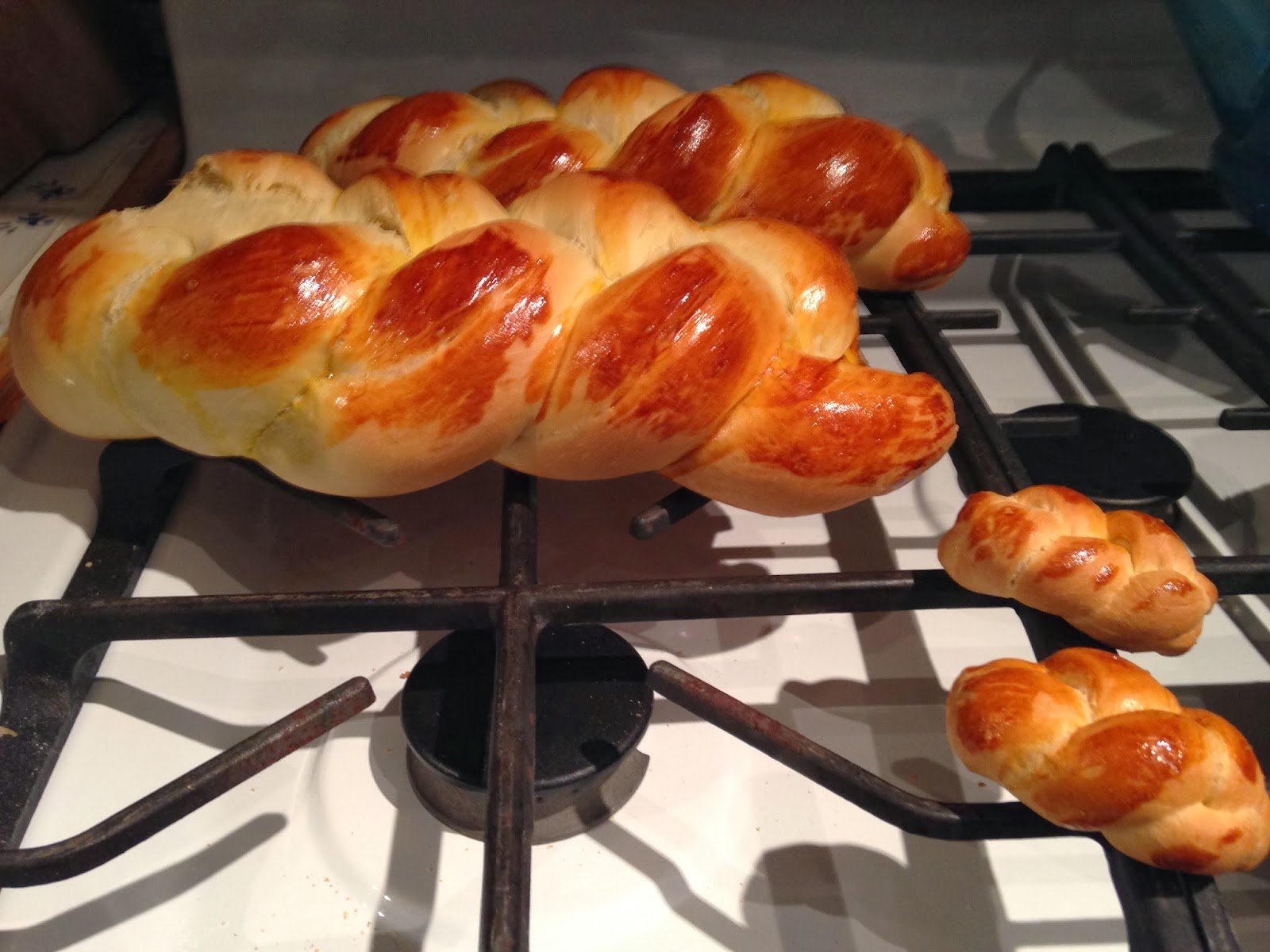
I made a challah for the Super Bowl. Makes me respect those amazing artists who bake and decorate in the Great British Baking Show. I am not quite addicted to the show, but I do enjoy it. For me, bread is decidedly not about looks, but the accomplishments of that show's bakers are mesmerizing indeed.

To brag about this meagre accomplishment, there were actual humans who recognized that this was indeed a challah football. Even those who did not make the visual connection - mostly those who never watch football - enjoyed the bread.

Next up: Bread #99, but after I try it one more time, this time with less anxiety and a little fresh rosemary.

Monday, February 19, 2018

Bread Number 97: Not a Challah Disaster

Confession #1: I made a major mistake and put all of the sponge into the dough instead of following the recipe and saving some.

Complaint #1: I don't like recipes that try to help me with extra starter to save. Just tell me how to make only as much sponge (or other pre-dough) as I need to make the bread at hand. I can take care of my own starter, thank you very much.

Happy day! Made an actual great tasting sourdough challah. But back to confession #1, the sponge mishap meant that the proportions were a bit off. Actually feeling great sense of accomplishment and hope for recipe when I follow most of actual directions.

Bread recipe adapted from Maggie Glezer’s My Sourdough Challah in A Blessing of Bread. I haven't reviewed this book yet because (a) my first attempt included a major deviation from the recipe, and (b) I have not read any other pages. I was so excited to see a true sourdough challah recipe that I did not wait for anything else.

Recipe and screw up

Sponge

35g starter
110g water
135g bread flour

I added an extra 30 grams of water because the sponge did not hold together at all with the recommended amount. Covered and let sit.

I let the sponge sit in a reasonably warm kitchen, maybe 70-72 degrees, for 12 hours. This was fine as the sponge was relatively dense, rather than wet. (We had a nice winter thaw; what a pleasure.) I awoke to a wet, beautifully bubbly starter.

Dough

3 eggs
60g water
56g oil
60g sugar
400g bread flour

Back to confession #1 and dough experience

What can you say about a recipe that takes more than a half hour longer to do a few simple steps than you think it will? You say it’s the first time I'm making this recipe. The dough was a sticky mess, really wet.  Did I say sticking to my fingers so I had about as much dough on them as was in the actual mass of dough?

I ended up adding about 40 grams of extra bread flour. I don’t know the exact amount because my hands were so sticky and full of goo that I could not possibly measure. Did I knead? I'm not sure what the process is called with something more akin to goop than dough.

Eureka moment and not in a good way: Oh fuck, I did it again. I added all of the starter instead of all but 50 grams. No wonder the dough was so wet. Shit. And it took a half an hour longer than expected, plus kitchen a mess, plus bleeding into work time on telework day. Serenity now.

Assumption at the moment

I clearly ruined this challah because proportions are off. Braided strands will blend. I’ll either throw this away, which I even considered doing before going any further, or I will make this in a loaf pan, maybe braided in a loaf pan. After recommended two hour wait not looking or feeling like a challah dough. Will try again.

Did the recommended two-hour wait, the dough covered and in a bowl.

I then divided the dough into three and braided them. Not sticky with extra flour on my hands and on the dough and on the kitchen counter. I was generous with the flour because I thought I had ruined the challah anyway. Oiled a loaf pan and placed the dough in it. Covered.

Supposed to sit for five hours, but  I let sit for 5 2/3 hours after a couple of dent tests.

Baking

Preheat oven for one hour at 325 degrees. Almost every challah recipe, including this one, says 350. Sorry, that temperature produces overdone challahs. We like less well done challahs. I felt confident in departing from the recipe on this one. I baked at 325 for 37 minutes.

Due to my own mistake, braids somewhat disappeared, but not completely, as I had predicted. After bread out of oven, spouse immediately sends photo to offspring about my treasonous deviation from usual recipe.

So much better than expected

Taste is actually pretty good; looks beautiful. Spouse impressed. Does not taste sour at all. Despite allegations of treason, spouse managed to eat quite a bit of this challah and it got eaten when I offered it to dinner guests about 24 hours later. In fact, compliments and comment of "this doesn't taste sour at all."

Not a disaster. Second try soon, without making same mistake, I hope. Crumb not bad either for what looked like a disaster in the making.


Monday, January 29, 2018

Bread Number 96: Yet Another Challah Disaster

I am thinking the core of this disaster is my failure to convert a yeasted challah recipe into a sourdough recipe. I followed two similar recipes and neither went well. I kneaded and kneaded by hand; I added extra flour because the doughs were way too sticky; and yes, I did the math so that the contents of the starter was accounted for in the calculation of the flour and water totals in the dough. This is clearly a voodoo-doll-type of conspiracy by my family members to prevent the replacement of their beloved challah with an identical challah that is made with sourdough starter instead of commercial yeast.

For hundreds of years, at least, challahs were made with starters because no commercial yeast existed. So somewhere in my quest, I am missing a significant piece of information pertaining either to ingredients or to methods - or to both.

Grumble, grumble, grumble - a considering of escalating to an adult equivalent of a toddler's temper tantrum - except that with my adult wisdom I am able to appreciate how unimportant, even to me, is this failure and that, as the granddaughter of someone who survived many baseball seasons of failed World Series, the best lesson is to regroup and try again rather than to throw in the towel and consider this a personal and a permanent failing.

[Off-topic: Maybe, as the granddaughter of a diehard Brooklyn Dodgers fan, that is not exactly the right analogy. I did cry when finally my beloved Brooklyn got a major sports team (the Nets, who play basketball) after many decades and at the exact spot where the Dodgers should have moved - instead of awful suburban, auto-oriented, Los Angeles.]

Screw that ... had a little tantrum a year later

After a year of not making any new breads - the above challah disaster occurred in January 2017 - I am finally getting back into experimentation. This weekend, I made a dough so bad that I threw it in the compost before baking. I was trying to adapt a yeasted rye bread recipe from The Hot Bread Kitchen for a totally naturally leavened rye bread. Really, I wasn't disciplined; I didn't manipulate the dough as needed and then I let it sit far too long for the first rise. Probably did not help that I was trying to do this alone with a broken arm.

My tantrum was not about the abysmal dough, but a whiny complaint that bread books (okay, almost) always only include commercial yeast recipes and no alternatives for breads only made with starters. So there I am making calculations, while trying to enjoy a normal weekend, and knowing that the timing will be completely different.

The key, actually, is to commit to being home and monitoring the dough. And to waiting until the arm is sufficiently healed to knead, stretch and fold, or whatever with two good arms.

Sorry for the long absence

Why the long absence? A mix of a friend's long illness and death, which was very depressing because he and his wife both died young after suffering terribly from cancer in their last months; getting lazy and making only breads I make well and that everyone at home enjoys; and then the, I hope, blip of the broken arm. Need mojo, commitment, and patience, but first to go back and retrace some steps to make doughs that require watchful waiting and better sourdough starter maintenance. Ah yes, got lazy about that as well and now keeping the starters out on the counter and feeding them more often.

Here is a nice post from Mike's Weekly Baking Tips that goes into detail about the tradeoff of convenience versus quality of refrigerating a starter.

Last word/last tantrum: I hate counting that challah attempt because it came out so terribly. Stomp, stomp, stomp. Time to shut up, stop whining and get back to bread.

Monday, March 28, 2016

Pre-Passover Pause and Spring Cleaning

I will be baking bread, just taking a break from the 108 Bread project. Tradition stands in the way, though only for a few weeks. My personal ritual is to start cleaning the minute that the Jewish holiday of Purim is over, which is now, which means angst, planning, scrubbing, and dusting until the holiday of Passover begins. Oh and shopping for items we only eat during Passover or which are bread related, such as mayonnaise, and, in my house, require a crappy mass-produced kosher supermarket replacement that often gets tossed after the holiday.

Not enough time for maintaining a chametz-related - Hebrew word meaning leavened - blog.

Zero bread - but just for a week

Now the central culinary aspect of the week-long festival is the absence of bread, any bread-like product, and, for many Jews, a whole list of other foods. I won't go into details; otherwise this post would become a PhD thesis. All leavened products and crumbs - hence the spring cleaning - are out, unless I have banished them to a sealed closet or cabinet. 

As bread #89 will be a matzo and I do not eat matzo between Purim and the start of Passover, I will delay this next venture. I want the first taste of matzo during the first Passover seder to taste special; it's not law, it's mishegas (a Yiddish word for a kind pf personal craziness). Also, I would like to use my very chametz-related baking stone, which would render the home-baked matzo so unkosher for Passover that even the dog would refuse to eat it on the holiday and cause him to scream out about a complete sacrilege being committed. He would probably scream with a Yiddish accent, a la any older Brooklyn person or Bernie Sanders. 

Curiously enough, this respite also allows me to procrastinate a bit more for the last 18 breads of the 108 bread project, the challah quest. I promise to complete this and get onto other possibilities, like selling bread, or teaching bread baking, or writing a book about bread baking from the perspective of someone who lives a normal life, fantasizes about bakeries, but really is not fit for the uber-organized requirements of the baker life, such as getting up before 7 a.m.

Tuesday, February 11, 2014

Addicted to my digital scale and other tales

I became crazed the moment I realized the digital scale was not working. It was literally right in the middle of mixing together a sponge for the third try at bread #46. I must have been leaning on it while I was talking on the phone and mixing the sponge at the same time. Early the next morning, I ran out for batteries, but new batteries did nothing. The error message kept appearing. The scale was broken. There was no troubleshooting chapter of the brochure, nor a page on the website with a miraculous fix. There is, however, a lifetime warranty on Escali scales, but the employees are not elves; they don't work weekends or respond to emails after five on Fridays.

I feel like I am in withdrawal.

I actually went back to old recipes for volume measures and for recipes where I translated my volume measurements for weight measurements - then worked backwards. I am hoping for a quick Escali response and an invitation to mail back the scale and have it fixed. My fragile balance of life is thrown out of whack.

Bread #46 in development
I am stuck on bread #46, a sourdough challah that I have already made three times. I want this to work. I feel close, but no cigar.

Rules
1. Do not make a dough, a sponge, or any pre-ferment at the same time as doing something else. I forget where I am in the recipe or I neglect to write down a measure or a time. Or something else, definitely something, will go wrong.

2. Do not talk to your best friend from high school, who lives half a world away - that's 12 time zones - in a high school-like chattering, wonderful conversation, and expect the bread not to suffer.

3. A dough is like a baby; it needs attention, especially at first.

4. After nine o'clock at night is as bad as five in the morning in terms of brain operations.

5. The aforementioned phone call was at about 9:30 at night. Two strikes against that bread. Still, the dough came out well. It was the overheated spot in the kitchen that precluded perfection.

6. Perhaps my family is using a challah voodoo doll to jinx this challah series because they already love my regular challah and they do not want to taste or become accustomed to anything else.

7. I apologize for using the word "addicted," because I read a few of the articles about the death of the late Phillip Seymour Hoffman, may he rest in peace, and there are so many people like him who are unable to overcome their demons, instead drowning themselves in narcotics or alcohol. So sad how many people he saw and interacted with in those final days, all of whom said how sick he looked, and no one reached out or pulled him in to take care of him.

8. Even with that perspective, life feels askew without my digital scale.

Sunday, January 26, 2014

Bread - Number 45: Beautiful Whole Wheat Challah

Bread - Number 45: Oy, but it's whole wheat and not sourdough. I'll kvell anyway.

What a beautiful challah and I followed instructions. My kneading worked. I loved it, perhaps swayed by the appearance as much as the taste. Isn't it always that way with love? My husband, however, is not feeling it. True, whole wheat masks the egg flavor to an extent, which to him means this is not a challah. I'm with him on that, although more open minded. 

This morning, day three of this challah, My husband announced he is buying a lousy bagel from Au Bon Pan because he does not want one more taste of this bread. The weird whole wheat/egg combination was too much for his stomach and mind to integrate.

Well, I like it and I am so proud that I made a challah with my own hands. This challah is part of a journey of needing to arrive at a place with a sourdough challah and without a bread machine to depend on. It's my slow food rebellion - one step at a time.

Master source for the recipe
I used the Peter Reinhart whole wheat challah recipe from his Whole Grains Bread book, which I have yet to read. I am going to read it now. This is a time-consuming recipe. Every five minutes you are doing something; well, maybe at half hour intervals. This one takes a few hours. It is not a "come home on Friday mid-afternoon to make a challah" recipe even if started the evening before. 

The only criticism I have - and the one instruction I refused to follow - was this would have been one overdone challah had it stayed in the oven for 50 or 55 minutes. I took it out at 35 without even using the thermometer. When it comes to challah, I have some experience (not counting the awful attempts of breads #43 and 44).

Ingredients and instructions
Erev baking day = the night before. Mix the soaker and the biga, separately.

Soaker
227g whole wheat flour
4g salt
170g water

Mix the soaker ingredients and cover with plastic. Let sit out overnight. My kitchen was on the colder side.

Biga
227g whole wheat flour
1g commercial yeast (I know, it was so sad not to use my wonderful starter culture)
28g olive oil
114g water
48g one egg
52g egg yolks

Mix the ingredients, cover with plastic and put the bowl in the fridge. Mine rose well overnight.

The recipe states that the soaker and biga can be left alone for 24 hours, so this bread can be tended to solely in the evenings. Just know that it will be a long evening when the dough has to be mixed in its final form, tended to, and baked. It will help if a household member, neighbor or whoever can remove the biga from the fridge in advance of a rushed arrival to get the challah going.

11 hours later
Early the next morning, a snow day (woo hoo!), I took the biga out of the refrigerator and let it sit for two hours before mixing with the soaker in my favorite dough bowl. This being a snow day, again hooray!, I could work while the biga warmed up in an actually heated kitchen. If this had been a late afternoon activity, I would have been fretting about getting this bread done on time for an evening meal. (Challahs do not need to sit before eating. Not in my house.) Though the directions advised cutting the soaker and the biga each into several small pieces before mixing, this did not work for me.

Using a favorite bowl is like using the pen you prefer (I realize some readers might never use a pen). Somehow having those tools and containers that you like make the whole experience feel right. I actually arranged the bowl usage so that the final dough would be mixed in the right bowl.

Dough
Soaker
Biga
57g whole wheat flour
5g salt
7g commercial yeast (at least it isn't a lot)
28g sugar or honey (I used honey)
28g olive oil

For later: poppy or sesame seeds and an egg yolk for getting the dough ready for baking

Mixing and waiting, working, and tending
Mix the biga and soaker together first. Then add the rest of the ingredients. The recommended two-minute mix to get a cohesive mass, of course, took almost 10 minutes. I kneaded for four minutes, which finally integrated the honey completely. Have plenty of flour on hand for turning the somewhat sticky mass into a smooth dough. I probably used about 100 to 120 grams of flour. I am not too proud to admit that I used regular bread flour at this point.

Cover the bowl with plastic and let rest.

Preheat the oven to 400 degrees Fahrenheit.

I let the dough sit for 45 minutes and it rose - at least to the eye - the requisite one and a half times. I was glad I worked early when the biga was warming because mid-morning seemed like I was off and on tending to the dough. After the 45 minute rest, the instructions were to cut - with a knife - the dough into the number of strands you will use for braiding the challah. I am still doing a three-strand braid, plus three tiny strands for the roll.

Slightly roll the pieces of dough into short, stubby strands and let sit - covered - for five minutes. During the rest time, get the egg wash ready. Reinhart recommends a wash of egg yolk and a tablespoon of water mixed. Roll the strands into their final shape before braiding. If you think of a rectangle, fold each length-long side in, one side over the other, and then roll the dough either between your hands or on the counter.

Braiding
I am afraid of anything more than three strands. I am almost ready to conquer this fear. Every time I look at four-to-six strand instructions, my eyes glaze over the same way they do when I read a book that describes a battle or navigation of foreign roads. One or two directional descriptions and I am totally lost. Where was the big hill or the little hill or Picket's fence at Gettysburg? Which army was where? I will need some meditation before I approach anything beyond the comfortable three strands that is so similar to braiding hair that I do not have to think about it.

Braid however many strands you like. Do the first brushing on of the egg wash. Cover with plastic and let sit for 30 minutes. Pray that this challah will be better than the last two. Use the rest of the half hour to work.

Second egg wash and prepare to bake
At the end of the half hour, I notice a good sign: The braids did not mush into each other. Sigh of relief. Place the dough on parchment paper that is on either a baking peel for easy transfer onto a baking stone (that is warming in the oven), or a parchment-lined baking sheet. Brush on the second coat of egg wash and sprinkle, or not, whatever type of seeds you prefer.

Let sit for 15 minutes. Reduce the oven temperature to 325 degrees right before baking. Place the challah dough, and the roll, if you made one, into the oven. If you are using a baking stone, remove the parchment paper after 20 minutes. At 20 minutes, the challah already looked gorgeous, with beautiful oven rise.

I removed the roll at 30 minutes and I took out the challah at 34 minutes.

Can a whole wheat bread constitute a challah?
This bread is wonderful. I love it. Not all opinions in the household agree. The dog is with me, but he sets a low bar for breads and challah is his favorite. I have to say the whole wheat masks the egg taste sufficiently that it does not really taste like a challah. I think it can still be considered a good bread. I even think it is a good challah for having when the picky challah experts in the family are not at home.

Monday, January 20, 2014

Bread - Numbers 43 and 44: How not to make a challah

Bread - Numbers 43 and 44: A recipe is someone else's instruction of what presumably works and something I have a hard time following
I tried this recipe twice, two different ways and two failed attempts at a sourdough challah. Even bread book authors who promote using a natural culture almost universally recommend commercial yeast in a challah dough. I tried making a sponge and an autolyse. I tried hours of rising. The first time, the braids were perfect, but the density was more hockey puck than bread. The second try, it was a good bread, but not a challah as it did not even keep the braids when it baked in the oven.

So, first the hockey puck and then the challah attempt that my husband likened to a dinner roll at a mediocre restaurant. I did not take pictures of the hockey puck. I was too depressed. I will summarize these attempts quickly as these are not meant to be recipes, but rather lessons or perhaps comic interludes.

From outside the Jewish bakery
I like the book Inside the Jewish Bakery and I am drawn to the time and place and bakery smells that it evokes, the mid century of New York City's Jewish neighborhoods and the bakery of my childhood, the bakery near the Met Food and the Lincoln Gardens Cleaners, down the block from Goody's Candy Store, a block and a half from home and less than a block from my elementary school, P.S. 209. (I grew up thinking it was the height of luxury to have a school with a name instead of a number.) This was a 10 minute walk from the best place in Brooklyn for a knish, Mrs. Stahls, the used bookstore that had every book one ever requested, though it was hardly bigger than a walk-in closet, and the ocean, the vast open space with its breezes and connection to faraway places.

I took the recipe for the bakery challah from Inside the Jewish Bakery and I changed it completely. Whatever bakery I was trying to evoke, I got something more Woody Allen making lobster than a professional baker preparing challah for the Sabbath. I can hear the comments in my head of all those teachers who told my mother I was bright, but I didn't listen.

Hockey puck
In separate bowls, I mixed the wet and dry ingredients, the usual for challah of bread flour, water, oil, salt, sugar and eggs. I used sourdough starter instead of commercial yeast. I kneaded for 15 minutes. I let the dough rise for an hour and a half; it barely rose. I kneaded for one minute and let the dough relax for a half hour. The braiding went fine. I did not like using a whole egg for the egg wash, as recommended. [Photo of a dough that barely rose.]


The dough looked pretty, but in the oven it did not rise one bit. It was a dense bread that looked - and felt- like a fake piece of food in a store window. At about 45 minutes, whereas I usually bake for no more than 35, I admitted defeat. One bit was enough. Not even edible. [Photo below shows normal looking strands waiting to be braided. Not very well shaped strands. Will have to take photos of nicer ones in future.]

Ingredients were ...
395g bread flour
45g sugar
7g salt
60g starter
69g egg yolks
23g olive oil
170g water
egg mixed for glazing
sesame seeds

The blame for the demise? Was there one critical mistake? I am going with inadequate kneading, but the rising time might have been way too long, giving a kick in the stomach to a bread that was already almost knocked out. Weird metaphor there.

Fluffy bread, but no challah
For the next round, adamant about making a sourdough challah and convinced that making the bread in three stages would yield better results, I made a sponge and an autolyse. An autolyse would mean less kneading.

Sponge
140g water
75g starter
160g bread flour

I let the sponge sit overnight in such a cold kitchen that the sponge might as well have sat in the refrigerator. However, with the heat on, by mid-day the sponge was nice and bubbly. The signs were much better this time around, I thought.

Autolyse
247g bread flour
54g water
56g egg yolks
59g one egg

I added extra egg because the moisture seemed lacking. The egg and the flour made for lumps of yellowish dough, which took more than a half hour at the dough stage to completely integrate. I let the autolyse sit with its uneven yellow and white mixture, for 20 minutes.

Dough
I added the sponge to the autolyse and:
7g salt
23g olive oil
120g bread flour approximately added during kneading
1 egg yolk for an egg wash (before placing dough in oven) (I neglected this part, but I usually do this for the nice finished look.)

The dough was too sticky and I added small amounts of flour while mixing and then kneading. The mixing concentrated on getting rid of the yellow lumps and creating a cohesive dough. My friend Brad was there to laugh with me and to add the flour. He taught me a different way to knead, which was more digging in and folding over than anything I had seen in the many kneading videos I had watched. Brad folded, dug in his heel, and repeated - many times. I took over and realized the small hands require more time for kneading.

I let the dough rise for three hours. It expanded, but I'm not sure it doubled. When it started to look a bit flat, I knew it was time to act or lose a second challah.

Dividing and braiding
I divided the dough into enough pieces for a challah and a roll, with three braids for each, tiny ones for the roll. I followed the advice to let the balls of dough, one for each braid, sit for 30 minutes. I braided and let sit for another 30. In my opinion, that final proof was a mistake; I should have braided, done the egg wash and put this baby in the oven. By the time it went into the oven, it seemed like the strands were mushing into one another. That's no insult to the book as I did not exactly faithfully follow any recipe in either method or ingredients.

Never let your friend peek in the oven
I hold fast to certain superstitions and one of them is not to peek into the oven unless a bread needs some assistance, such as removal of parchment paper or a cover during baking. My friend follows different rituals. Brad looked and he nagged me right into the kitchen. Oh so sad! In the oven, at 325 degrees, the bread rose. It looked like a fluffy Italian bread. The only evidence of the braiding was a zig zag line down the middle, which eventually opened a bit, almost like a cute artisanal signature that was more Walmart goes natural than authentic challah.

The bread tasted fine, nothing special. It had the texture of a fluffy roll. All we were missing were small plastic serving containers of butter for that Applebee's or Denny's-type experience.  

The energy of my family is pushing me away from making a challah any way other than the way I have always made it. Where I feel I might end up with this journey within a journey of a challah series is another way to make the challah I have always made, except to learn to make it without the bread machine.

But wait ... The next bread, a whole wheat challah, which I just tasted, came out marvelous. That will be bread #45. I can almost smell the ocean from near the old bakery at Coney Island Ave. between Y and Z, just up the block from Goody's. 

Still hoping for a good sourdough challah.

Friday, January 17, 2014

My orginal challah recipe - a family favorite

Before there was bread, there was challah

Before I even thought of making bread, I made this challah - every week in my bread machine. And the story starts with my husband, who ate bread every day. I would go to a local bakery in DC and buy him a boule; then in Brooklyn, when I had our older daughter, I would buy an Italian bread. She would sit up in the backpack and I would give her the end to munch on as we walked home. When she was old enough, Brooklyn being a magical place, the woman behind the counter would give her a cookie everyday.

Almost 20 years ago, my mother, may she rest in peace, who adored my husband, bought him a bread machine for Chanukah, which he used for a couple of months. She also bought my sister one as well and my sister promptly started making challah dough in the bread machine, which she makes to this day. I did not touch the machine.  I had no interest in bread.

[Photo: Just-baked small challahs from one batch of bread machine dough. I always bake a roll for each challah.]

What happens without a good bakery

When we moved back to DC, the bread machine stayed with boxes in the basement. And then, discovering that there is no good Jewish bakery (sacrilege to eat supermarket challah in my own personal list of religious rules), and wanting my children to grow up with fresh, good challah every Friday night, I asked my sister for her recipe. I thought I was being a regular Betty Crocker just to be making my own challah, even though the bread machine was doing 90 percent of the work. I take the dough out of the machine, and to this day I braid, always using a small piece of dough for a braided roll (except for the high holidays, when I make round challahs and challah rolls), and bake the challah in the oven. 

[Photo: Sometimes the end of the challah separates a bit, but the braid stays.]

For years, this was the only bread I made. I was proud of it and I was intimidated by the idea of doing anything further, especially without the trusty bread machine. I added a 100 percent whole wheat bread - bread negative one - and there my repertoire stayed for 10 years or so. The challah was such a favorite that every time I visited my parents I would bring one and when my daughters each went off to college, it was frequently requested as a treat. Many frozen challahs have traveled with them to school. Another couple of close friends have become regulars, which makes me very happy because my parents are gone now and I miss their enjoyment, their fussing over this bread.

Challah is also my dog's favorite. He once ate a whole one right off the counter. 

Challah recipe
Before the challah series starts, it is fitting to pay homage to this bread, which always comes out well. I can make this in my sleep. It is my Friday afternoon ritual to come home from the office, don an apron, and make the challah. Once the machine is turned on, I do a little artwork and prepare for Shabbat in between having to pay attention and tend to the dough. By the time the challah is ready, Shabbat is starting or about to. Every week, this challah comes out perfect.

Ingredients
2/3 to 3/4 cup water
1/4 cup oil (I use olive oil)
2 eggs
1 tsp salt
3 1/2 cups bread or all purpose flour
1/4 cup sugar or honey (reduce water a bit if using honey)
1 tbsp yeast
1 egg yolk (to brush on for a nice finish)
poppy or sesame seeds, optional

Instructions
Put in the bread machine the wet ingredients - water, oil, eggs. Add salt and bread flour. Add honey now if not using sugar. Make a well or two in the flour. Add the sugar and the yeast.

[Photo: Ingredients for challah in the bread machine pan. Sugar and yeast on top of flour, with liquid on the bottom.] 

Set the bread machine for the dough cycle. When the bread machine has been mixing for five to seven minutes, check the dough. I set my timer for 28 minutes because my bread machine sits for a while before mixing the ingredients. I only check after at least five minutes of active mixing.

Usually the dough is fine, I walk away and continue with my Friday afternoon routine.

[Photo: Dough after five minutes of mixing.]

If the dough is crumbly or dry looking, add water. For dry, maybe a teaspoon. For crumbly, the dough might need a tablespoon or more. Add no more than a tablespoon at a time. Give the machine a minute or two and check again now that the extra water has been mixed into the dough. If the dough, on the other hand, is sticking wetly to the sides, add a little flour, maybe a tablespoon. The latter almost never happens. Check again after a minute or two. Keep the bread machine on. Very rarely, this can take another 10 minutes.

Holiday challah raisin mix
It is traditional for the Jewish New Year and for that first month to make a round challah with raisins. Really,one can make a regular challah with raisins as well. 

Add to dough
1 cup raisins
cinnamon to taste (don't be shy, maybe 1/4 tsp to 1/2 tsp)
1 tsp vanilla extract 

Mix the raisins, cinnamon and vanilla extract together. Taste the mix. It should NOT be sweet, but more of a sharp cinnamon taste. The sweetness will come with the integration of this mix into the dough.

Maybe ten minutes after the dough check, add the raisin mix. I make sure that the raisin mix is well incorporated throughout. I have also forgotten and added the mix after the dough is ready and that works as well.  

[Photo: Dough after initial mixing stage of approximately 15 minutes of mixing and kneading.]

Getting the dough ready to bake
A half hour to an hour before the dough cycle is complete, preheat the oven to 325 degrees Fahrenheit. I use a baking stone, which gives a nice bakery-like finish to the bottom of the bread. No steam  or la cloche is necessary.


[Photo: Challah dough at the end of the bread machine dough cycle. Ready to be prepared for baking.]

When the dough is ready, I braid. My braiding has improved because I now roll each strand before braiding and I braid from the middle to the ends of the challah. I flatten slightly the dough for each strand and fold in the long sides to make a fat tube-like shape, sort of making a envelope while not keeping the rectangular shape. Very easy to make a braided roll. I only use three strands, like a hair braid, but I might very well experiment with that as well.

I spread some egg yolk on top and sometimes put sesame seeds on top. Poppy seeds are also a traditional option.

I bake the challah for 30 to 35 minutes. Remove the roll at 30. 

[Photo: Braided dough with egg yolk for two rolls and two small challahs on baking stone in oven. This is from one batch of dough.]

Other shaping options
If you a making a challah or challah rolls for the high holidays, here are instructions for making a round challah and a round bunch of rolls.

Round challah
Use a round pie or aluminum pan. Otherwise, beware, you might get a strangely-shaped bread. Line with parchment paper. 

Basically, except for the ends, stretch the dough into one very long rectangle about two feet long and six inches wide, approximately. Taper the ends so that they are about half to two-thirds the width of the middle. 

Wrap the dough as though making a spiral and tuck the end underneath. Make sure the middle of the circle of dough is low. Otherwise, it can pop up high and make a weird shape in the oven.

Brush on egg yolk. Bake at 325 degrees for 32 to 35 minutes.

Round rolls en masse
Something that always goes over well, whether plain or made with the raisin mixture, is a round robin of rolls made together. Use a pie or round aluminum pan. Line with parchment paper. 

Make miniatures of the round challah shape described just above. Make 10-15. Put them side by side in the pie pan until they are totally scrunched together.

Brush on egg yolk. Bake at 325 degrees for 32 to 35 minutes. The rolls will bake all as one, but they will be easy to break off separately. 


[Photo: Close up of the baked small challahs. They have a homemade look.]

That's it, the sum of my challah knowledge. Well, that and the memory of what a good challah dough feels like as I roll the strands or shape into a round holiday challah. Every time I make this bread, I think of all the Friday nights of my childhood making Shabbos around the kitchen table and the peace in my house that descends when I light Shabbat candles and we partake of this special bread. And after we say the prayer over the challah, the motzi, we all grab a bit and the dog gets his share. This is his favorite bread.

Tuesday, January 7, 2014

Bread resolutions for 2014

Crafting some plans as I move on from bread #42

Utmost in the bread part of my brain is a plan, followed by some resolutions and then the equivalent of tiny pieces of paper with little notes scribbled on them - some in the form of random thoughts.

The challah plan is not well received
My daughters are off traveling and at school, both far away, far enough to finally start my long-planned challah series. They are both adamantly opposed to any change in the perfect challah they know and love, the one made every week since they were very small. [Photo: Deli in San Fransisco. They make a great havarti sandwich. Right in the Castro, up the block from the last streetcar stop.]

My husband is unenthusiastic as well. He likes the challah and the French Toast made from it and he doesn't want to eat more of what is essentially a white bread. He's all in favor of more whole grain, crusty breads. To reassure him, I will continue to make the favorites and he can contribute to the challah series by taste testing. There are friends and colleagues I think I can count on for that as well. Food disappears pretty quickly from my office kitchen and it's been a while since I brought in a home baked bread.

I woke up on this cold, grey Sunday morning and searched the indices of all of my bread books for recipes and created a handwritten table in my bread notebook to roughly compare egg to flour ratio and whether there were unusual ingredients or usual ingredients missing. The recipes range from two eggs or three eggs to a couple of eggs and up to four yolks. Some have a lower egg to flour ratio than mine and some it is impossible to tell. These are the recipes that measure egg amount in grams or in fractions. I'm not sure how one can reliably add half of an egg. That's what a digital scale is for.

Right now, there are 11 recipes. Well, there are more, but I intend at this point to try 11. Inside the Jewish Bakery is the source of quite a few. I passed over one egg-less recipe because there is no such thing as an egg-less challah. [Photo: The beautiful oven at Frank Pepe's pizza in New Haven. Worth going out of the way for.]

2014 bread resolutions
  1. Challah series - at least three.
  2. Taking photographs of the making of the doughs and breads.
  3. Not doing anything bread related until at least 6:45 in the morning and never while rushing to get out the door to go to work.
  4. Experimenting with more types of flours.
  5. Going through more bread books and experimenting with recipes.
  6. Maybe a bakery tour.
  7. Not totally bread related - figuring out how to make a really good corn muffin. I bought cornmeal on sale for this purpose. 
  8. Experiment to find a nice hot chocolate recipe.
Let me just say that not everything on this list will happen. This is perhaps a 2014-2015 resolution list. I like taking the bread journey slowly. [Photo: Broadway Deli in England, not anywhere in the City, obviously. That's NYC, by the way.]

My eyes are too big for my time
As for the random thoughts and post-its with bread names and the print outs of recipes I do not want to forget, I will get to them along the way.

Hoping for myself, my family and friends, and anyone who reads 108 breads or who has happened across this particular post, a very healthy and happy 2014. May you have fun, love, happiness and sweet surprises all through the year.